
What is demand intelligence?
A live, product-level read of demand most retailers don’t have — what it is, how it’s built, and where social proof actually fits.
Every online store runs on data it reads at the wrong time. Analytics tells you what happened — last week’s bestsellers, yesterday’s conversion rate, the report that lands on Monday. Demand forecasting, where retailers have it at all, tells you what might happen next quarter, so you can decide how much to buy. Both are useful. Neither answers the question that actually decides revenue: what is happening to demand right now, for every product in my catalogue — and what should I do about it before the moment passes?
That question is Demand Intelligence. It’s the layer most retailers don’t have, sitting in the gap between the report that’s too late and the forecast that’s too far out.
The short version
Demand Intelligence is a real-time, product-level read of what shoppers are responding to right now — built from live behaviour on your store, not from historical sales reports.
Every store already produces the raw material: products being viewed, added to bags, bought, going out of stock, climbing and falling in rank. Today that activity is scattered across an analytics tool, a merchandising dashboard, and a stock system, and almost all of it is read after the fact. Demand Intelligence turns it into a single, continuously updated answer to one question — what is the current state of demand for every product? — and makes that answer something a store can act on, not just look at.
Why this is a new category
The term Demand Intelligence has existed for years, but mostly in enterprise supply-chain software: demand forecasting, replenishment, sales and operations planning. That version is backward-looking and slow. It predicts next quarter’s units from last year’s sales, and its audience is planners and buyers.
What we mean by it is a different thing on three counts. It’s real-time, not forecast — built from live behaviour, refreshed continuously, measured in minutes and hours rather than quarters. It’s product-level, not aggregate — every product carries its own demand state, momentum, and risk profile, not a category trend line. And it’s operational, not back-office — the intelligence doesn’t sit in a planning tool waiting to be queried; it acts, on the storefront and across the stack.
If enterprise demand intelligence asks how much should we buy?, this asks what is happening to demand right now, and what’s the strongest response?
How it’s built
Underneath, Flockr maintains a live demand model — a truth record — for every product in the catalogue. Three layers turn raw activity into something you can act on.
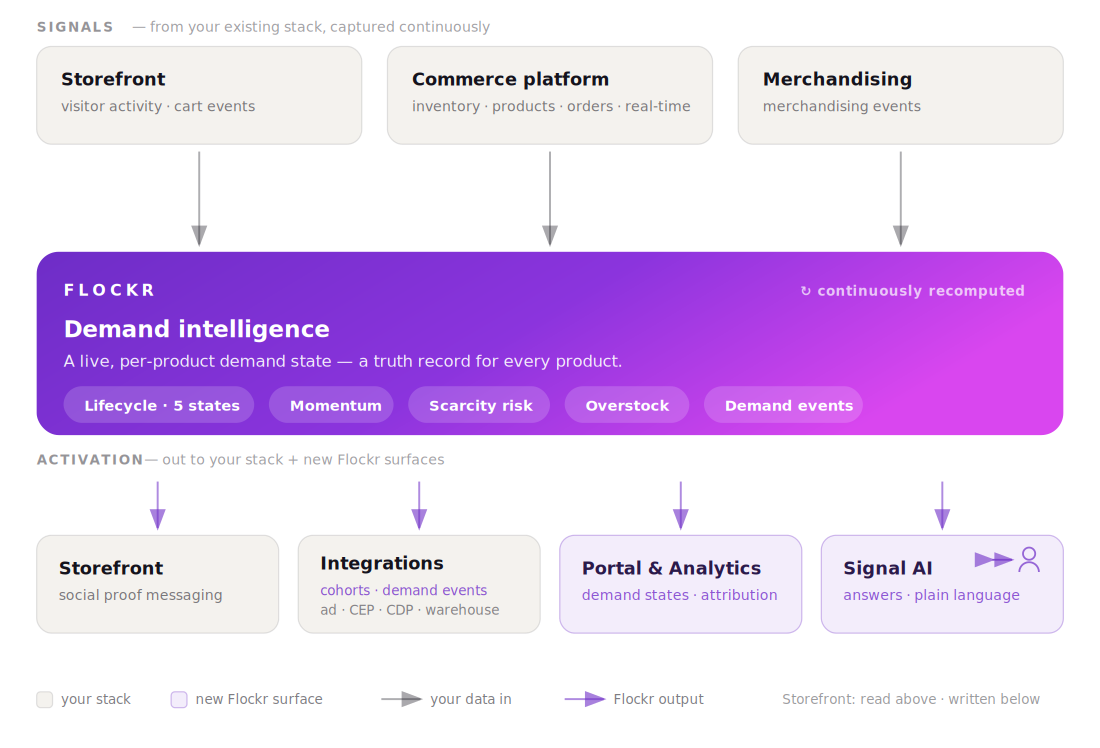
Signals are the raw inputs, captured continuously. Demand velocity — the rate of views, add-to-bags, and purchases — is tracked across nine rolling time windows, from the last few seconds out to seven days. That spread is what lets the system tell a genuine surge apart from ordinary noise. Alongside velocity sit popularity and rank, live scarcity and stock trajectory, and each product’s position in its lifecycle.
Intelligence is where signals become demand state, and it’s the part that matters. Every product is automatically classified into one of five lifecycle states — Just launched, Discovering, Trending new, Declining new, or Established — computed from its behaviour against its launch date, not its calendar age, so you can see at a glance whether a new-season drop is breaking out or stalling. Momentum is measured by comparing each product’s recent activity against its own baseline, which surfaces products that are surging — and, just as usefully, products that are fading before the decline shows up in the weekly numbers. Scarcity risk combines stock runway (how many days of inventory remain at the current sell-through rate) with live demand, so the products about to sell out while still in demand rank to the top. Overstock is the inverse: deep inventory with weak demand, scored so carrying-cost risk surfaces before the season ends. And when something meaningful changes — a lifecycle transition, a demand spike, a cart surge, a rank change, a low-stock crossing, a restock — the system emits an event, in real time.
Activation is the part most tools skip, because it’s the hard part. Intelligence only matters if it changes what happens, so the same demand model feeds every output. On the storefront, it selects and renders the strongest piece of demand evidence for each product, in context, in milliseconds. In the portal, it’s a live operational view of catalogue demand — what’s trending, fading, at risk, overstocked — with the commercial impact measured. Through Signal, the platform’s assistant, you can ask in plain language which new arrivals are gaining traction or which low-stock products to reorder first, answered from the live model. And across the stack, demand states and events flow into the rest of your tooling — cohorts, ad platforms, CRM, merchandising — so a product entering “trending new” or “scarcity risk” can trigger action anywhere, not just on-site.
Where social proof fits
This is the right place to put social proof messaging, because it’s where most people first meet the idea — and where it’s most often done badly.
Only 3 left. 12 bought this today. Trending this week. Those messages are everywhere, and most of them are guesses: a badge a merchandiser switched on weeks ago, a counter incremented on a timer, a “trending” label applied because someone decided a category should trend. The message is on the page, but it isn’t connected to anything happening in the store right now.
In a Demand Intelligence system, the message is the opposite — it’s an output, not an input. The storefront message is simply the most legible expression of demand state the system has already computed. The badge says “selling fast” because the model has measured that it is, this hour, on real numbers. Nothing is authored. Nothing is invented. Social proof messaging was the first visible application of Demand Intelligence — it was never the whole of it.
Analytics tells you what happened. Forecasting tells you what might happen next quarter. Demand Intelligence tells you what’s happening right now, per product — and acts on it.
Why it matters commercially
Most teams trade on lagging indicators. The weekly report tells you what happened; Demand Intelligence tells you what’s happening while there’s still time to do something about it.
That changes four things. Breakouts get caught early — a product accelerating gets amplified on-site and across channels while interest is peaking, not after the report lands. Revenue at risk gets protected — short stock runway plus rising demand is the most expensive thing to discover late, and it’s ranked for you continuously. Dead stock gets activated sooner — overstock surfaces as a scored list to feature, bundle, or mark down before it ages out. And every team reads from one live demand model instead of four conflicting dashboards.
Two properties make it trustworthy as well as useful. Because the storefront messaging is generated from verified live signals rather than static rules, its impact can be measured properly — held against a two-group control so you see what it actually earned, which is the basis of our contractual 8× minimum return on licence fee. And none of it requires knowing who your shoppers are: Demand Intelligence reads product demand in aggregate, without collecting or storing personal data about individuals. The intelligence is about the products, not the people — which makes it both simpler to deploy and far less fraught to run.
The category, in one line
For most of e-commerce’s history, the storefront has shown messages that sound like they’re based on real demand without being based on anything at all, and the teams behind it have traded on reports that arrive after the decision had to be made. Demand Intelligence closes both gaps. It treats live demand as a first-class signal a store can compute, observe, and act on — on the storefront, in the portal, and everywhere else demand is worth knowing.
That’s the category we’ve spent the last few years building Flockr to be.
If you want to see what it looks like on a real catalogue, book a walkthrough.