
Ask your store.
Every analytics tool answers questions you have already translated into its language: reports, date ranges, filters. Flockr Signal answers the question you actually have, in plain English, grounded in the live state of your own catalogue.
You always have a question in plain words. What is losing momentum that I should worry about? Which low-stock products actually need restocking first? Why is this jacket suddenly everywhere?
Your tools do not answer questions. They render reports. Between your question and their answer sits a stretch of translation work: which report holds this, which date range, which filters, and then, once the table loads, the interpretation. You become the layer that turns a business question into a tool's language and the tool's output back into an answer.
Some questions survive that journey. Most do not. They are not urgent enough to justify ten minutes of report archaeology, so they go unasked, and the store stays slightly less understood than it could be. That gap between having a question and getting an answer is what Flockr Signal removes.
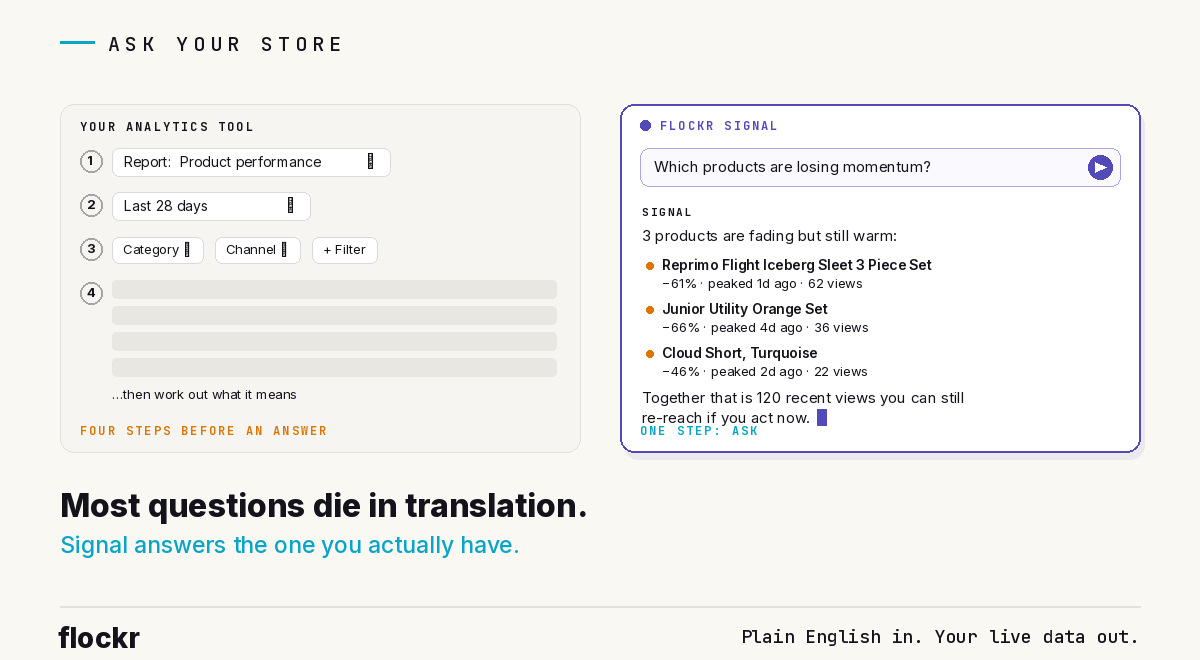
Ask the question you actually have
Signal is the assistant built into the Flockr portal. You type a question the way you would ask a colleague: "Which products are losing momentum?" It answers in seconds, streaming as it works, with real products and real numbers from your store: the three items fading but still warm, each with its decline, when it peaked, and the recent views you could still re-reach
Then you keep going. "Why?" works as a follow-up. So does "what about on the PLP?" or "show me the same for last week." Signal holds the thread of the conversation, so each question builds on the last instead of starting from zero.
The important claim, and the one that separates this from most of what currently wears the "AI assistant" label: Signal is not a generic chatbot bolted onto a product. Every answer is grounded in your catalogue, your configuration, and your live data. Ask a generic assistant about your conversion lift and it will produce something fluent and empty. Ask Signal and it reads the actual figure, from your actual attribution data, for the actual date range, and tells you what it is.
Three layers of knowledge
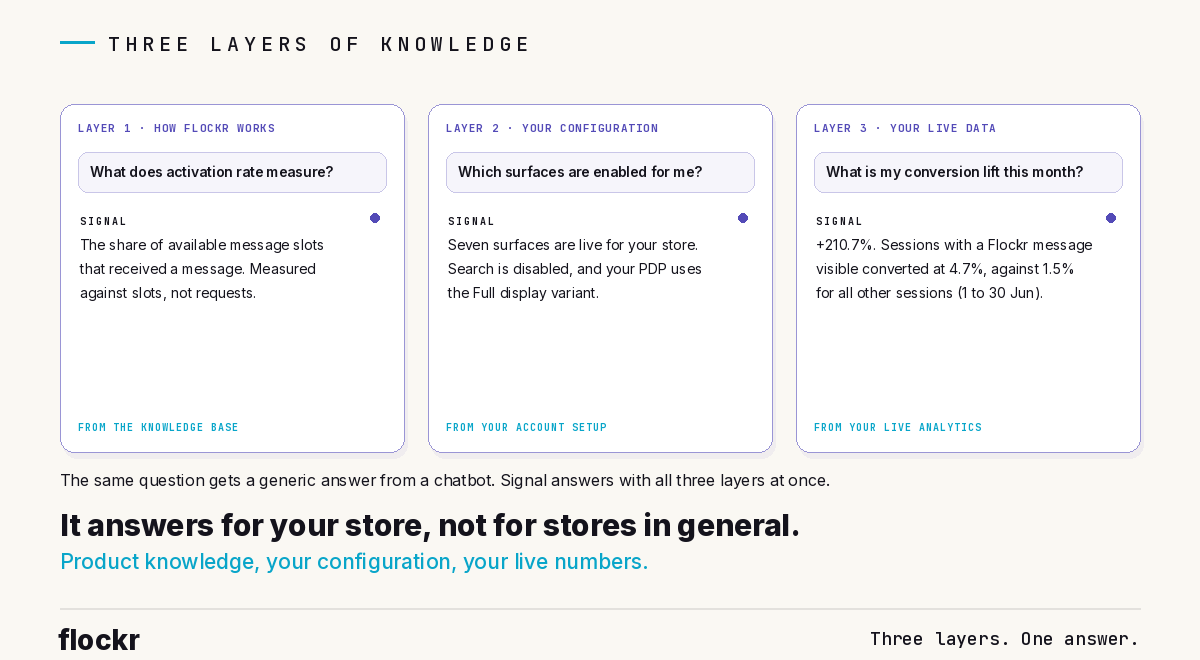
What makes the answers trustworthy is where they come from. Signal draws on three distinct layers, and the difference between them is worth understanding, because it is the difference between an assistant that talks about software and one that answers for your store.
It knows how Flockr works. Signal is grounded in a knowledge base built from the system itself, not marketing copy. Ask "what does activation rate measure?" and it explains the real definition: the share of available message slots that received a message, measured against slots rather than requests. Ask why a certain signal never appears near checkout and it can explain the eligibility rules that govern it. This is the layer that makes Signal useful on day one, before you have learned the platform's vocabulary.
It knows your configuration. The same question gets different answers on different stores, because stores are set up differently. Ask "which surfaces are enabled for me?" and Signal answers for your account: which of the eight surfaces are live, which display variants are in use, what has been switched off. Generic documentation cannot do this, because generic documentation does not know you.
It knows your live and historical data. This is the layer that changes what the assistant is for. Signal has a set of live-data tools, fourteen of them, that pull real figures on demand: what is trending and what is fading, which products carry scarcity risk or sit overstocked, how rankings have moved, what your conversion lift and incremental revenue look like, what is happening on the store right now. When you ask "which low-stock products need restocking?" the answer is a list of actual products with actual runways, not advice about inventory management in general.
Three layers, one answer. A question like "is my activation rate good, and what would improve it?" touches all three at once: the definition, your setup, and your numbers. That is the point.
The store suggests the questions
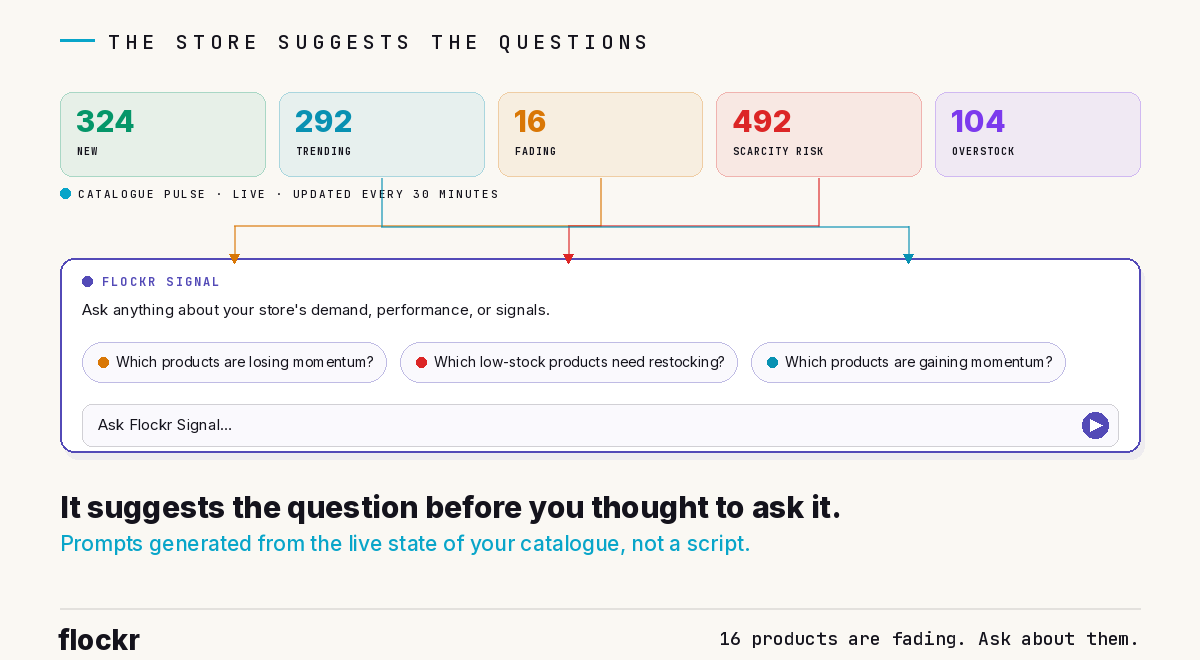
There is a quieter feature that says a lot about how Signal is built. The suggested prompts underneath the input box are not a fixed list someone wrote once. They are generated from the live state of your catalogue.
If products are fading, "which products are losing momentum?" surfaces as a suggestion. If a meaningful share of the catalogue is at scarcity risk, "which low-stock products need restocking?" appears. The suggestions change because the store changes, which produces a small but genuinely useful inversion: the store proposes the questions worth asking before you thought to ask them.
The same idea runs through the portal's insight cards. When Flockr surfaces an insight, an "Ask Signal" button sits beside it, so the moment a finding raises a question, the question has somewhere to go.
An honest assistant
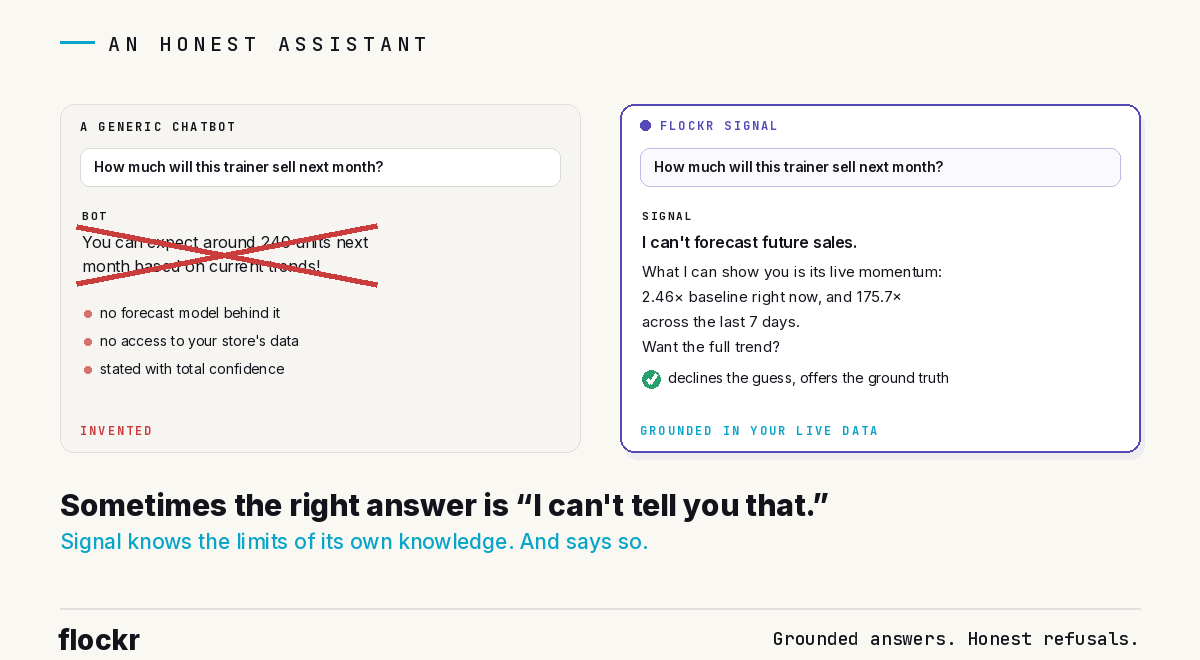
The fastest way to lose trust in an assistant is to catch it making something up once. After that, every answer needs checking, and an assistant whose answers need checking is slower than no assistant at all.
So Signal is built with explicit limits, and it respects them visibly. Ask it something outside its knowledge, a sales forecast, say, and it does not improvise a confident guess. It tells you it cannot answer that, and then offers what it genuinely can: the live momentum behind the product, the trend so far, the current runway. Ask it something that belongs to a different part of the portal and it points you to the right page rather than paraphrasing badly. Its answers are grounded in retrieved sources, from the knowledge base or from your data, rather than generated from vibes.
This is the same principle that runs through everything else Flockr does, from attribution that calls itself observational to scarcity messages that never claim more precision than the data supports: the system does not pretend to know things it does not know. In an assistant, that principle has a very simple expression. Sometimes the most useful answer is "I can't tell you that, but here is what I can."
From answer to action
An answer is rarely the end of it. Signal is built for the follow-through: drill into a product the answer mentioned, ask for the same view over a different window, or have it draft something you can actually use. Ask for a summary of this week's demand movements and you get a short, structured update, real products, real numbers, ready to paste into the message you were about to write to the buying team.
And because Signal sits on the same live state as the rest of the platform, it connects naturally to the insights Flockr surfaces: the recommendations routed to merchandising, buying, and product ops. The insight tells you what is worth doing; Signal is where you interrogate it. Export the list, or ask the next question.
Dashboards show. Signal answers.
A dashboard shows you data and leaves the questions to you. A report summarises a period you chose in advance. Signal answers the question you actually have, about your actual store, right now, and admits it when it cannot.
It is the third way into the same live demand intelligence: the storefront messages are what shoppers see, the portal is what your team sees, and Signal is what you ask. If you would like to put questions to your own catalogue, the Signal AI page walks through it, or book a walkthrough on a real store.