
Demand intelligence for e-commerce: the four decisions it changes
Every store, every day, is deciding where to point attention, what to protect, what to stop spending on, and what to clear. Most teams make those four calls on lagging information: the weekly bestseller report, the trailing thirty-day numbers, the stock count read without reference to demand. By the time the data confirms the decision, the window to act on it well has usually closed. Demand intelligence doesn't change the decisions. It moves them earlier — to the point where they're still worth making. Here are the four.
1. What to amplify — while it's still taking off
A previous piece set out what demand intelligence is: a live, per-product read of demand, built from real behaviour rather than historical reports. This one is more concrete. It's about what that read actually does for an e-commerce business — and the honest answer is that it doesn't add new decisions to your week. It changes the timing of four you're already making.
A product starts to move. Views accelerate, add-to-bags climb, it begins outpacing everything around it. This is the most valuable signal a catalogue produces, because attention spent on a product that's already rising compounds: a homepage slot, an email feature, a bump in ad budget all return more when interest is building than when it's settled.
The problem is timing. By the time a breakout shows up in the weekly bestseller report, the surge is days old — and your finite placement, budget, and email real estate are still pointed at last week's winners. You amplify what already peaked.
The decision demand intelligence changes is where to point attention, now. Momentum is measured against each product's own recent baseline, across rolling windows from seconds to days, which is what separates a genuine breakout from ordinary noise. A product entering a surge is surfaced while it's surging — in hours, not at the week's close — so the slot, the feature, and the spend land while the interest is live.
2. What to protect — before it sells out while still wanted
The single most expensive thing to discover late is a product that was converting well and quietly ran out of stock. Every visit after that is a lost sale you never see, because the only trace is absence.
A stock system on its own can't warn you about this. It shows units remaining, but units remaining means nothing without demand: five hundred units of something nobody wants is fine; eight units of something selling out every hour is an emergency. The two numbers live in different tools and almost never get read against each other in time.
The decision here is what to prioritise protecting — which products to push up the reorder list, which promotions to pull back on because the item will sell through unaided anyway, where holding price is safe. Demand intelligence makes that call answerable by crossing stock runway — how many days of cover remain at the current sell-through rate — with live demand, and ranking the products about to sell out while still in demand to the top. The revenue most at risk surfaces while there's still time to defend it.
3. What to stop spending on — before the numbers say so
This is the inverse of the breakout, and the one teams miss most often, because a fading product looks healthy for weeks. On a trailing thirty-day report it's still a "top seller." Its cumulative numbers are strong. So it keeps its homepage slot, keeps its place in the email, keeps drawing ad spend — all while its actual, current demand is draining away.
Cumulative totals are a rear-view mirror. They tell you what a product has sold, which is exactly the wrong question when you're deciding what to keep investing in. The right question is whether demand is rising or falling right now, and a thirty-day total can't answer it.
The decision demand intelligence changes is what to stop feeding. By measuring momentum against each product's own baseline, it flags a decline as it begins — before it shows up in the totals — so placement, budget, and attention can be redeployed off a product on its way down and onto one on its way up. You stop paying full freight for fading inventory.
4. What to clear — before it becomes a markdown
The fourth decision is the slow one. Inventory accumulates against weak demand: stock you over-bought, a line that didn't land, a seasonal range losing its pull. Left alone, it resolves itself at end-of-season as a deep markdown — the most expensive way to clear anything, and a decision made under pressure when no better option remains.
Discovered earlier, it's a far cheaper problem. A shallow discount now, a bundle, a feature placement, a nudge through email — any of these clears stock at a fraction of the eventual write-down, but only if you can see the carrying-cost risk forming while there's still runway to act.
The decision is what to clear, and how gently. Demand intelligence scores overstock continuously — deep inventory set against weak and weakening demand — and surfaces it as a ranked list well before season's end, so clearing becomes a series of small, early choices rather than one large, late one.
The shift, in one line - The decisions don't change. The information you make them on does — from what a product has done, reported after the fact, to what demand is doing right now, while the choice still matters. That's the difference between trading on a rear-view mirror and trading on a live read.
Four decisions, one model
It would be easy to read the above as four features, or four tools you'd buy separately — a trending-products widget, a stockout alerter, a fade detector, a dead-stock report. It isn't. The four decisions fall out of a single thing: one live demand state, computed per product, continuously.
That matters commercially, because the alternative — assembling these reads from four disconnected systems — is how most teams end up with four dashboards that disagree. When breakout, scarcity, fade, and overstock are all different readings of the same underlying model, they're consistent by construction, and a product moving from one state to another is visible as a single event rather than a discrepancy between tools.
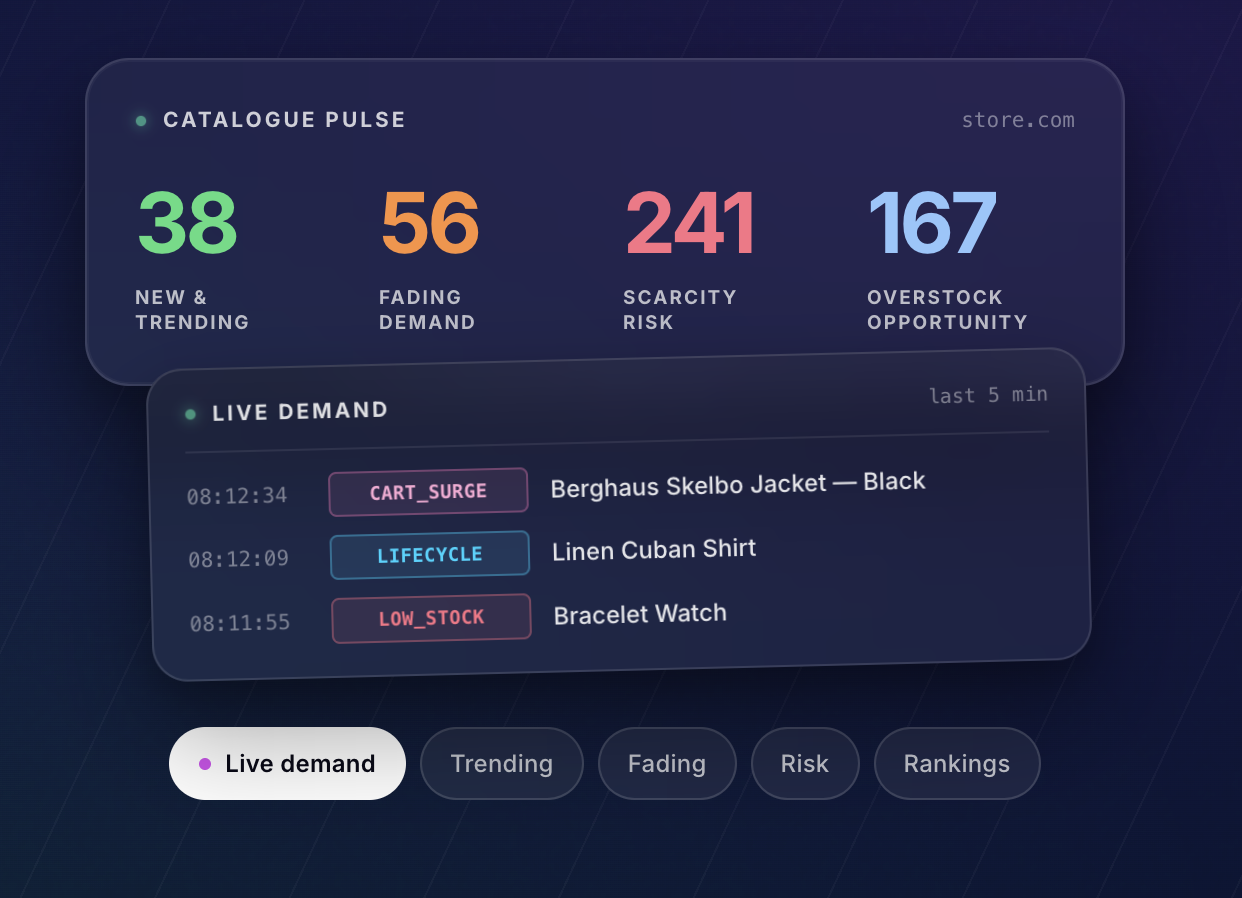
In practice the four decisions get made in three places. The portal is the operational view — trending, at-risk, fading, and overstocked products laid out live, with the commercial impact attached. Signal, the assistant, answers the same questions in plain language: which new arrivals are gaining traction, which low-stock products to reorder first. And because the model emits events when a product changes state, those decisions can be automated outward — a product entering scarcity risk can trigger a reorder flag, a CRM campaign, or an ad-platform adjustment without anyone watching a screen.
One property is worth stating plainly, because it removes the usual objection. None of this requires knowing who your shoppers are. Demand intelligence reads product demand in aggregate — it's about the products, not the people — so there's no personal data to collect, store, or justify. The four decisions get sharper without the privacy overhead that usually comes with behavioural data.
If you want to see the four states on a real catalogue, book a walkthrough, or read more about the demand intelligence layer itself.