
When one social proof message should say two things
Look at the social proof message on almost any storefront and you'll find a single fact. "12 bought this week." "Only 3 left." "150 viewed today." Each one is true, each one is useful, and each one is doing the same thing: surfacing one piece of evidence about what shoppers are doing.
The problem with one fact
Most of the time, one fact is right. A product that's simply selling well needs to say so and nothing more — piling on extra claims is how a storefront turns its messaging into noise. But some of the time, one fact isn't the whole fact, and the part left out is the part that would actually have moved the shopper. That gap is what this piece is about.
Consider a product that is both selling fast and running out of stock. Two things are true at once, and they reinforce each other: lots of people want it, and there isn't much left. To a shopper deciding whether to buy now or come back later, that combination is far more persuasive than either half alone — "popular" invites deliberation; "popular and nearly gone" closes the loop.
A single-signal tool can't say it. It shows "selling fast" or "only 3 left" — one or the other — and discards the rest. And here's the important part: it doesn't discard the second signal as an editorial choice. It discards it because it never computed it. A tool built to read one kind of evidence has nothing else to reach for. The runner-up isn't suppressed; it was never there.
So the question isn't "why don't these tools show more" — showing more, indiscriminately, is the wrong instinct. The question is why a single message can't tell the whole truth when the whole truth is what matters.
One message, not more — but a fuller one
It's worth being exact about what changes, because the temptation here is to break a rule that's worth keeping.
Flockr's engine still does what it has always done: for each slot on the page, it evaluates every product and selects the single strongest, most relevant message. One message per slot. The page stays deliberately sparse — weak signals still show nothing, and a product with one thing to say still says one thing. None of that changes, because saturating a page with badges is exactly how you train shoppers to ignore all of them.
What changes is what the winning message is allowed to carry. Instead of selecting the strongest signal and throwing the runner-up away, the winning message can absorb a second signal — when that second signal is real, and reinforces the first. Not more messages. One message, telling more of the truth.
Three messages that say two things
The clearest way to see it is the single-signal version beside the combined one.
Demand and scarcity. The single-signal message says:
Only 3 left in stock.
The combined message says:
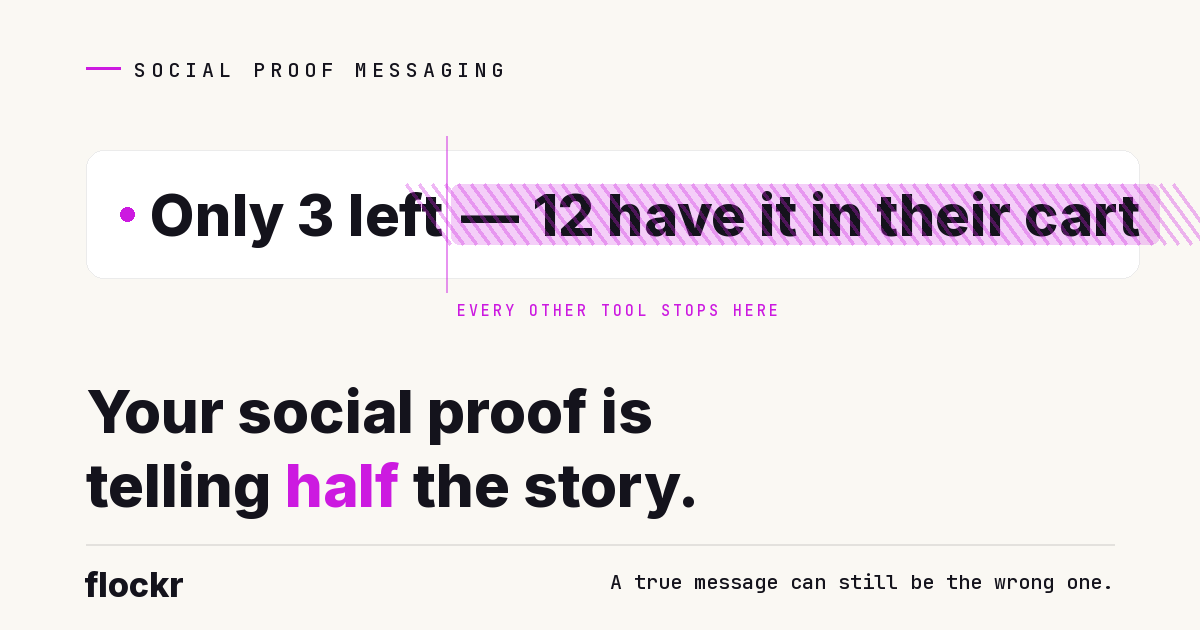
Only 3 left — 12 have it in their cart.
The scarcity is the same; what's added is why it matters now. "Only 3 left" could mean a slow product with thin stock. "Only 3 left, and 12 people are holding it" means the shelf is about to empty under your feet. The cart figure isn't decoration — it changes the read of the scarcity.
Newness and momentum. A brand-new product is where single-signal messaging is weakest, because a new arrival has no history to draw on. The best a one-signal tool can manage is a label:
New in — recently added.
Which is honest, and inert. It's a fact about your catalogue, not evidence about the product. Combine it with early momentum and it becomes proof:
New in — and already gaining attention fast.
Now it's not just new; it's catching on. That's the single most useful thing you can say about a new product, and it's invisible to any tool that doesn't compute momentum — which is most of them. It's also the answer to the cold-start problem every store has with fresh stock: how do you build confidence in a product with no track record? You show that the track record is starting.
Intent and scarcity. Demand can be building before it shows up in sales — people committing, adding to bags. On its own:
45 added to bag recently.
Paired with shrinking stock:
Going fast — 45 added to bag, and stock is running low.
Note what this one doesn't do: it adds a second axis without adding a second number. "Stock is running low" is a state, not a count, so the message reads as one clean line of urgency rather than a stat sheet. That restraint is deliberate, which brings us to the rule underneath all of this.
The discipline that keeps it honest
Combining signals is only an asset if it stays disciplined. Done carelessly it produces exactly the clutter the rest of a good messaging system is built to avoid — "Only 3 left · 12 in carts · 18 bought today · #2 bestseller" is not persuasive, it's a dashboard bolted to a product card, and shoppers tune it out. So the combination follows hard rules:
Two axes, never more. A message carries at most two reinforcing signals, and at most one of them is a number. Two facts a shopper can hold; not five.
Reinforcing, never contradictory. Signals combine only when they point the same way. "Selling fast and almost gone" reinforces; "selling fast but overstocked" would confuse, so it never renders.
Never redundant. "Low stock — only 3 left — most sizes gone" is one idea said three times, not three signals. Combination adds a different axis, or it doesn't happen.
And it won't fake the compound. This is the part that matters most. A new product that hasn't actually started moving stays "New in — recently added" — the system does not invent the momentum to make the message stronger. The combined message appears only when the second signal is genuinely there. The willingness to show the simpler, truer message is what makes the fuller one believable when it does appear.
Why only a full-signal system can do this
Step back and the reason single-signal tools stay single-signal becomes obvious: combining signals requires having computed them all in the first place. You can't fold momentum into a newness message if you don't track momentum. You can't pair cart pressure with scarcity if cart pressure isn't a number you hold. And you can't know which pairings reinforce and which contradict unless you're modelling the product's whole demand state, continuously, in real time.
That's not a messaging feature. It's a property of the layer underneath — the demand intelligence that already computes every signal for every product, every minute. The combined message is simply the most legible expression of a system that was reading the whole picture anyway. A single-signal tool isn't choosing brevity; it only has one signal to give.
Which is the same point the rest of this story keeps arriving at: the message is only ever as good as the intelligence behind it. If you want to see what your own catalogue's messages would say with the full picture behind them, the social proof messaging page walks through it — or book a walkthrough on a real store.