
Your "new" badge has one job. Most stores get it wrong.
Almost every store flags its new arrivals, and almost every store does it the same way: someone adds a "new" tag to the product, and the storefront shows a little badge wherever that tag appears. It's such a routine piece of merchandising that nobody really questions it. Worth questioning anyway, because the standard approach has three quiet problems — and fixing them turns out to say something larger about how a store knows what it knows.
The tag is a stand-in for something the store already knows
Start with what a "new" tag actually is. It's a human-maintained marker for a fact the store already has: this product was published on this date. Nobody needs to tell the store a product is new — it watched the product get added. The tag exists only because the badge had no way to read that event directly, so a person steps in to translate "this was just published" into a label the storefront can display, and then is supposed to translate it back off again when the product stops being new.
That translation layer is the source of all three problems.
Three ways the manual tag fails
It's upkeep, and upkeep slips. Every new product needs the tag added, and every product that's no longer new needs it removed. At ten products a season that's a minor chore; across a large, fast-moving catalogue it's a standing task that quietly falls behind. The result is on storefronts everywhere: products wearing a "new" badge they were given three months ago, because adding the tag is someone's job and removing it is nobody's.
It's binary. A tag is on or off, which means it can say exactly one thing: new, or not. It cannot tell the difference between a product that launched this morning to silence, a product that's starting to get noticed, and a product that's genuinely taking off. All three get the identical badge, or none do. The single most useful distinction a "new" badge could draw — is anyone actually responding to this? — is the one a tag structurally can't.
It goes blind. Because tags accumulate and rarely come off, the badge ends up on a large slice of the catalogue at any time. And a badge that's on everything stops being information. Shoppers learn to skip it the same way they skip a banner ad — not because "new" doesn't matter, but because a signal shown indiscriminately trains people to ignore it. The manual tag defeats its own purpose at scale.
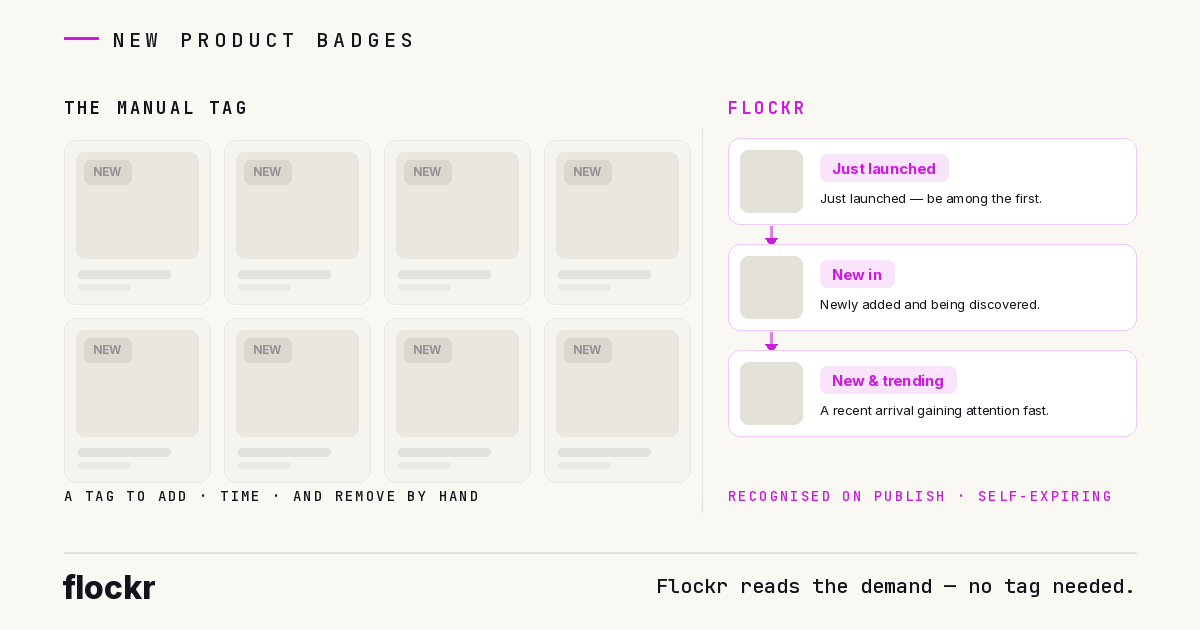
Recognised on publish — no tag at all
The fix isn't to automate the tag. It's to remove the tag from the process entirely.
When a product is published to the store, that event already flows through the systems the catalogue runs on — a webhook, an API, a product feed. Flockr reads it there. The moment a product goes live, Flockr knows it's new; there is nothing to add, because the thing the tag was standing in for is an event Flockr can simply see. No tagging, no timing, no app maintaining tags on a schedule. The product is published, and the badge is earned from that instant.
That removes the upkeep problem at the root — there's no tag to forget to remove. But it also opens up the two harder problems, because once the badge is driven by what Flockr observes rather than a static flag, it can do things a flag never could.
A badge that knows what stage the product is at
Being new isn't a single state; it's a short arc, and Flockr classifies where a product sits in it from live demand — its views, add-to-bags and purchases since launch. A new product moves through three stages, and the badge says the true thing at each:
Just launched — newly live, with little demand history yet. The badge reads "Just launched — be among the first." Note what it doesn't do: it doesn't claim popularity it can't yet support. With no traction to point to, it leans on the one thing that is true — primacy — and invites the shopper to be early. Honest at the one moment a manual badge is most tempted to over-promise.
Discovering — early interest is building; views and add-to-bags are starting to come. "Newly added and being discovered." Now there's genuine, if early, response, and the badge can say so.
New & trending — a recent arrival with accelerating demand. "A recent arrival that's gaining attention fast." This is the payoff: newness and momentum in one badge, which is the most persuasive thing you can say about a fresh product — and which is invisible to any system that only knows a product's publish date.
The badge also fits the space it's in: a compact form for a tight product-tile corner on a listing page, a fuller form where there's room on the product page. One earned signal, phrased for where it appears.
And it retires itself
The other half of upkeep is removal, and it's handled the same way: by demand, not by a person or a timer. A product stays eligible for a newness badge for its first thirty days, and only while it's genuinely in one of those new stages. When the window passes, or when momentum fades and the product settles into its established demand pattern, the badge simply stops — automatically. Nothing to remember, nothing left lingering. The badge stops claiming "new" at the point "new" stops being the most useful, truest thing to say about the product.
Why a badge needs this much underneath it
None of this is really a badge feature. It's a small, visible expression of the layer underneath — the demand intelligence that's already reading every product's lifecycle and momentum in real time. A manual tag is what you reach for when you can't see that: a proxy maintained by hand because the underlying state was invisible. Once the state is visible — published-on event, demand stage, momentum — the proxy isn't needed. The store knew all along; something just had to read it and say the true thing.
That's the whole point in miniature. The "new" badge looks trivial, and it is a good place to see the idea clearly: stop maintaining stand-ins for facts your store already holds, and let the system read the facts directly. If you'd like to see what your own new arrivals would say, the social proof messaging page walks through it — or book a walkthrough on a real store.