
Newness isn't a switch. It's a curve.
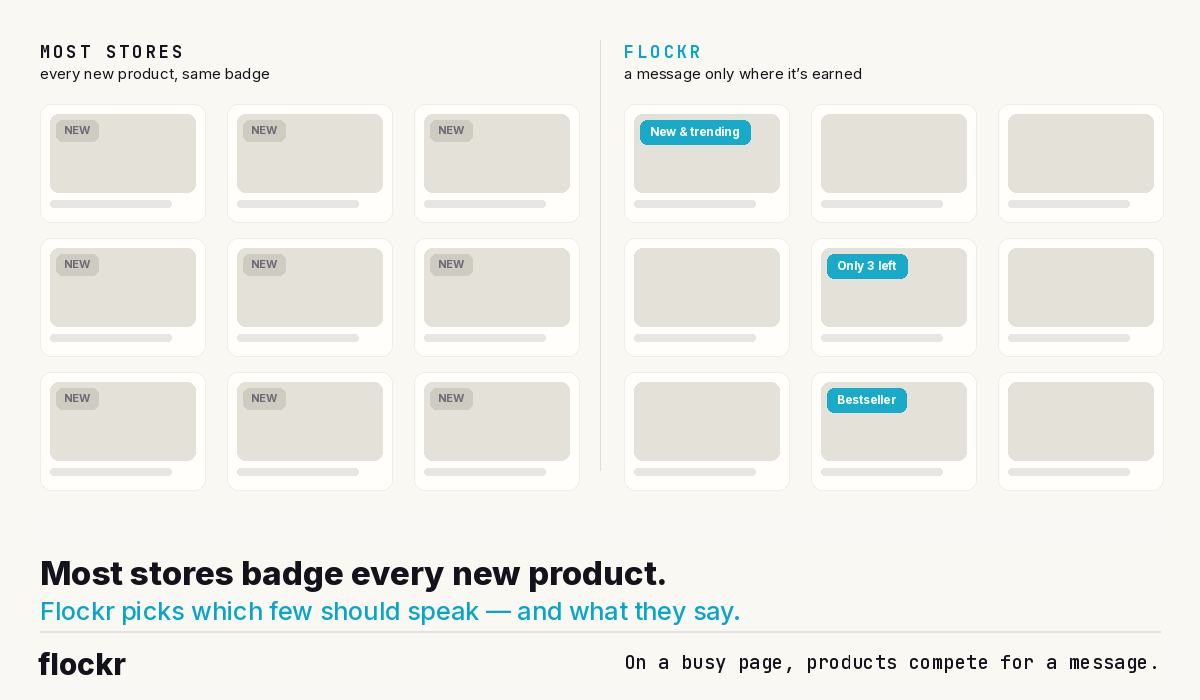
Start with the constraint everyone ignores. On a multi-product page, message slots are scarce — not every product can carry a badge, because a page where everything shouts is a page where nothing is heard. That's the banner-blindness problem the manual tag creates: badge every new arrival and you've trained shoppers to skip the badge.
Not every product gets to speak
An earlier piece made the case against the manual "new" tag: it's a date stamp someone has to add and remember to remove, it's identical on every product it touches, and because it ends up on half the catalogue, shoppers stop seeing it. Flockr's answer was to drop the tag entirely — recognise a product as new the moment it's published, show a badge that reflects which stage of "new" it's actually in, and retire it automatically.
That covered which products are new, and when to stop. It left the more interesting question untouched: on a listing page with dozens of products, which new products actually earn a shopper's attention — and how does "new" compete against everything else a product could say about itself?
Because that's the real situation. A storefront has far more it could say than it should. And the difference between a store that converts and a store shoppers tune out is almost entirely in what it chooses not to say.
Flockr treats the page as what it is — a limited amount of attention to allocate. Rather than badge everything, it shows a message only where one is genuinely earned, and leaves the rest quiet. The few messages that do appear get noticed precisely because they're not everywhere.
Which raises the obvious question: earned how? For each product that could carry a message, Flockr evaluates the true things that could be said about it — and shows the single strongest one. Most products show nothing. A few speak. None of them shout over the others.
Newness is one contender, not a guarantee
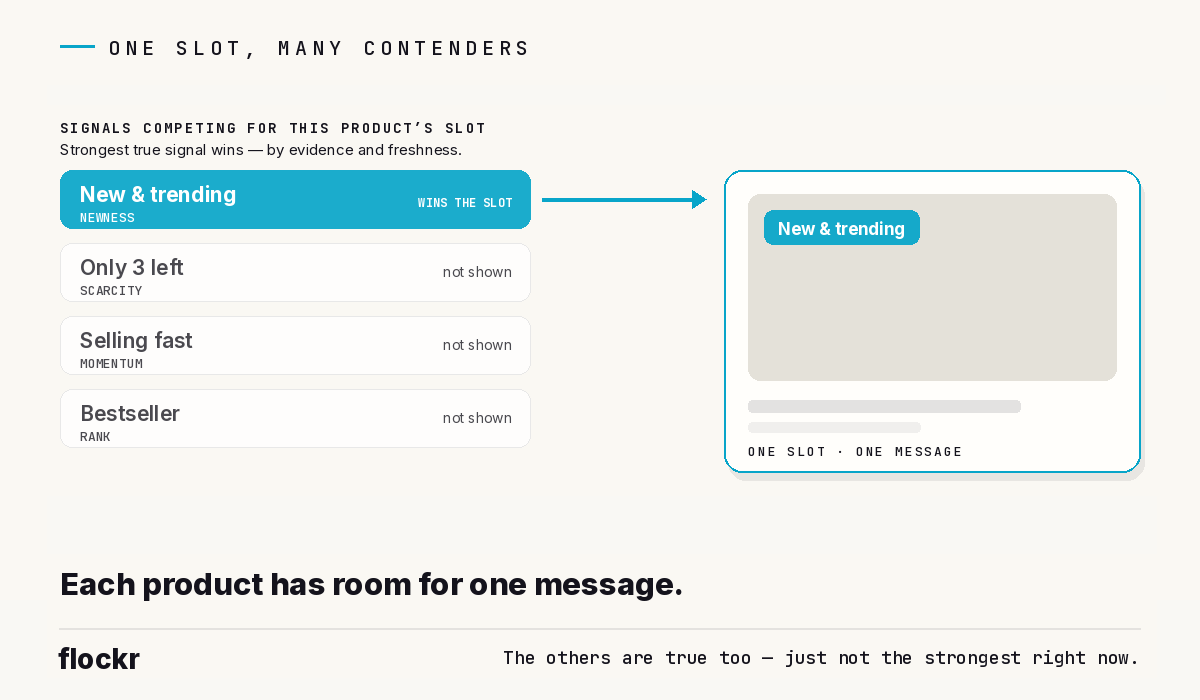
Zoom in on a single product. Several true claims might be available for it at once: it's new, and it's running low, and it's selling fast, and it's a category bestseller. All true. But the product has room for one message, so they compete — and the strongest true signal for that product, at that moment, wins the slot.
Newness is one of those contenders. Sometimes it wins; often it doesn't. A product that's both new and nearly sold out might be better served by the scarcity message; a new product that's quietly climbing the bestseller list might lead with rank. The losing signals aren't false — they're true too, just not the most compelling thing to say right now. This is the discipline that keeps every Flockr message trustworthy: not "say everything that's true," but "say the one true thing that matters most.
So newness has to earn its slot against real competition. Which is exactly why treating it as a binary on/off flag — the way a tag does — leaves so much on the table. A flag can't compete; it's either present or absent. To compete well, "new" has to be more than a fact. It has to have a strength.
"New" isn't one thing — it has two dimensions
Here's where Flockr's version of newness departs from a tag entirely. "New" isn't a single state; it's a position along two independent axes, and a product's competitive strength comes from both.
The first axis is evidence — how much the product has actually proven. A just-launched product is a new claim with almost no data behind it. A product that's been live a little longer and is gaining early views and add-to-bags has measurable traction. A recent arrival whose demand is genuinely accelerating has the strongest case of all: novelty and proof. These are real differences in how trustworthy the "new" claim is, and Flockr weights them accordingly — a trending-new product competes harder than a just-launched one, because it's earned more.
The second axis is freshness — how compelling the novelty is right now. And this is the one a tag can't express at all: two products can both be genuinely "new," but a two-day-old arrival and a twenty-five-day-old one are not equally fresh. "Newly added" is exciting on day two and stale on day twenty-five, even though both are technically inside the new window. Freshness isn't binary, and it isn't constant — it changes over a product's life.
Newness has a strongest moment
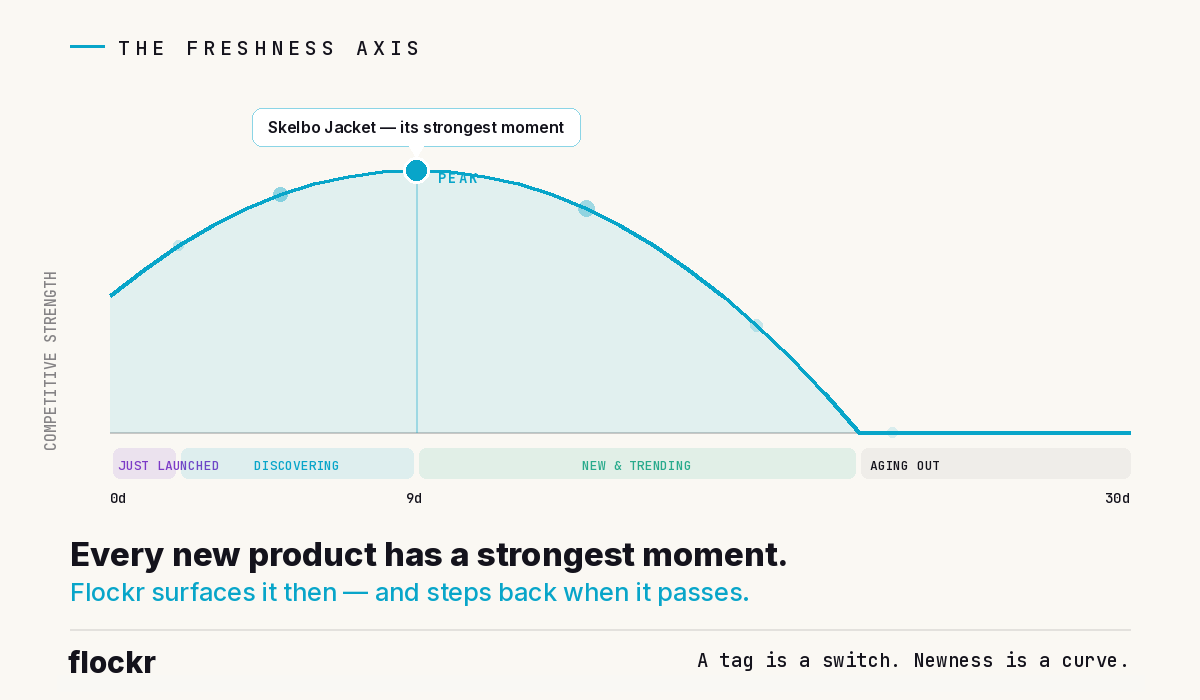
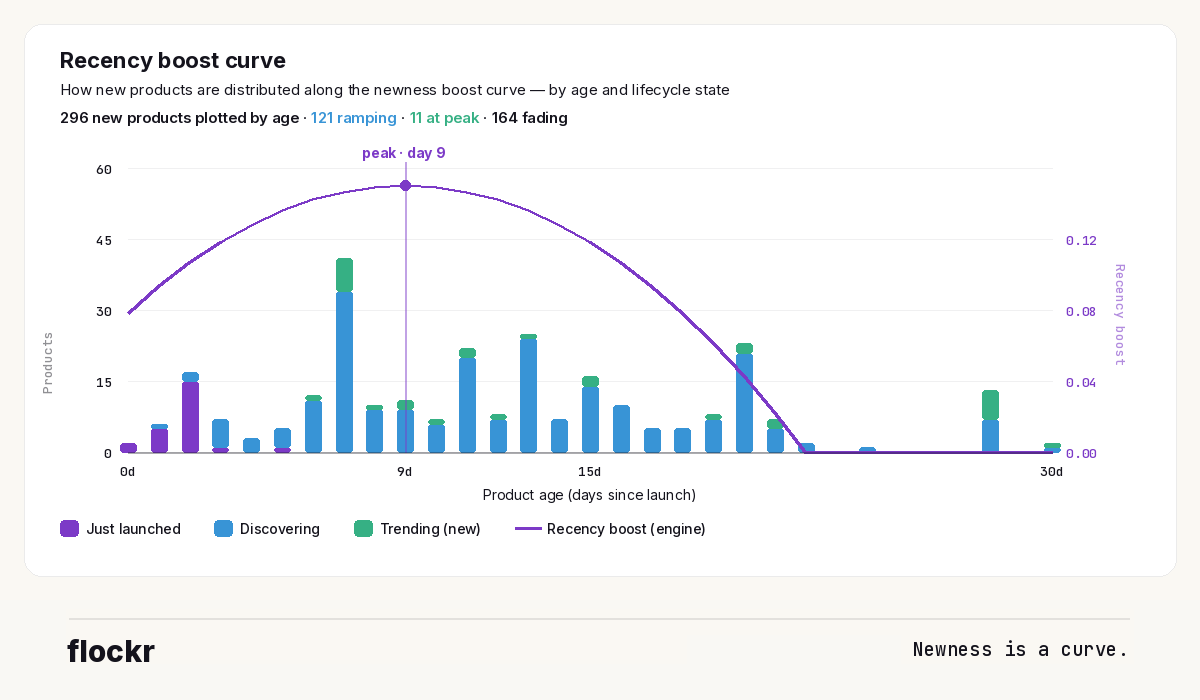
Put freshness on a timeline and it has a shape. A new product's competitive strength isn't flat across its first month — it builds over the early days as the product establishes itself, peaks while it's genuinely fresh and gathering interest, and then fades as the novelty wears off, reaching nothing well before the thirty-day window even closes. After that, the product simply competes on its other merits, like everything else.
That shape is the whole idea, and it produces three behaviours a tag never could.
A genuinely fresh product competes harder — its newness is at full strength exactly when "new" is the most compelling thing about it, so it's more likely to win a slot and get surfaced during the window that matters.
A stale "new" product steps back — once its freshness has faded, its newness stops competing, so it no longer crowds out products with something more useful to say. The page doesn't fill up with month-old "new" badges, because aged newness quietly loses the contest.
And — a principle worth being explicit about — newness can only ever help a product compete, never penalise it. An aged-out new product doesn't get pushed below where it would otherwise sit; it just loses its boost and competes on merit. Newness lifts; it never punishes.
One more piece of honesty is built into the same mechanism. A brand-new product is given strength to compete, but Flockr doesn't pretend it has more proof than it does — the certainty attached to a just-launched product stays appropriately low, because it genuinely has less behavioural history. Flockr lifts how hard a fresh product competes without overstating how sure it is. Help the new product; don't oversell it.
"New" and "trending" are not the same thing
A clarification that falls out of all this, because the two get conflated constantly. New is about a product's age — where it sits in its lifecycle since launch. Trending is about acceleration — demand rising faster than its own baseline, regardless of how old the product is. A new product may or may not be trending; a product that's trending hard might be two years old. They're genuinely different signals, and Flockr keeps them distinct rather than blurring both into a single "new & hot" label. A product earns the trending signal by accelerating and the newness signal by being recently launched — and the strongest of whatever's true wins the slot.
The difference, in one line
Most stores treat newness as a switch: a product is new or it isn't, and every new product gets the same badge until someone turns it off. Flockr treats newness as a curve — a signal with a strength that rises, peaks, and fades — competing for a shopper's limited attention against everything else a product could say, and winning it only while the product is genuinely at its freshest.
The result is the opposite of banner blindness: not a wall of identical "new" badges, but a few well-timed messages on the products that have genuinely earned them, at the moment they're most worth showing. The earlier piece showed how Flockr knows a product is new. This is how it decides whether being new is worth saying. If you'd like to see it run on your own catalogue, book a walkthrough — or read how the demand intelligence layer underneath it works.