
Social proof in e-commerce: what actually moves conversion
Search "social proof" and you'll find the same article in a hundred variations: testimonials, case studies, influencer collaborations, user-generated content, follower counts. All of it real, most of it useful — and all of it about one thing: persuading people before they reach your store. This piece is about the other place social proof operates: on the storefront itself, during the session, at the moment a shopper is deciding. The mechanics are different, the failure modes are different, and — unusually for anything in marketing — the impact is directly measurable.
What social proof actually is
The underlying principle is older than e-commerce: when people are uncertain, they treat other people's behaviour as evidence. The busy restaurant must be good. The product everyone else is buying is probably the safe choice. Psychologists call it informational social influence; Robert Cialdini gave it the name that stuck.
Online retail supplies near-perfect conditions for it. A shopper faces thousands of close substitutes, can't touch anything, and has no one to ask. The behaviour of other shoppers is often the only independent evidence available — which is why it carries so much weight at the decision point.
In e-commerce, that principle shows up in two distinct forms, and most discussion blurs them together.
Channel social proof is accumulated reputation: reviews, star ratings, customer stories, press coverage, client logos, follower counts. It builds slowly, changes slowly, and does its work before and around the visit — in search results, on social media, in the consideration phase.
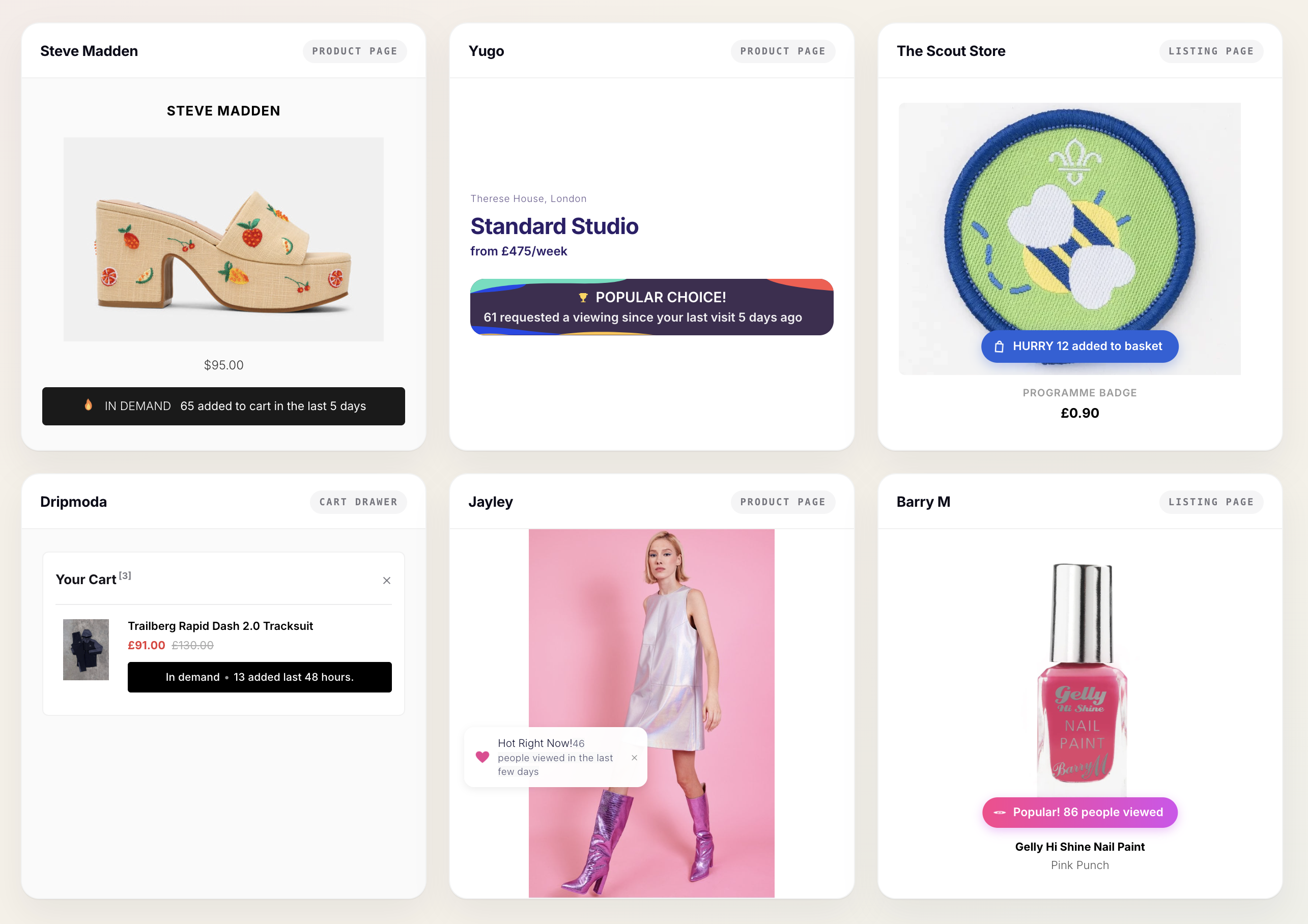
Behavioural social proof is live evidence of what other shoppers are doing right now: viewing a product, adding it to their bags, buying it, selling it out. It exists only in the moment, it's specific to the product on the page, and it does its work during the session — on the product page, in search results, in the basket.
Almost everything written about social proof covers the first form. Almost all of the conversion impact available to a retailer sits in the second — because it operates at the exact moment of decision, on the exact product being decided about.
A message is only as good as the signal behind it
Every behavioural social proof message is a claim about demand. Selling fast. Most viewed in knitwear today. Only 3 left. Back in stock. No. 2 bestseller this week. Behind each claim there is — or should be — a measured signal: a velocity, a rank, a stock position, a restock event, a position in the product's lifecycle.
A storefront generates more of these signals than most teams realise. Flockr's demand model, for instance, tracks eleven distinct signal families per product, from view and add-to-bag velocity across rolling time windows down to stock runway and lifecycle state. The taxonomy matters less than the principle: the message is the legible surface of a signal. Decide what's true first; the wording is the easy part.
Which leads directly to the line that separates social proof that works from social proof that quietly costs you.
Real or fabricated: the only line that matters
Here is a test you can apply to any social proof message, on any store, including your own: can this message be traced to a signal that was measured, on this product, recently?
A surprising amount of what's deployed today fails it. Countdown timers that reset on refresh. "Selling fast" badges a merchandiser switched on three weeks ago. Viewer counters incremented by a random number generator. "Bestseller" labels applied to whatever needed clearing. The message is on the page, but it isn't connected to anything happening in the store.
Fabricated social proof carries three costs, and they compound.
The regulatory cost is no longer theoretical. Regulators on both sides of the Atlantic have moved from guidance to enforcement: the UK's CMA has pursued retailers over misleading urgency and scarcity claims, the Digital Markets, Competition and Consumers Act gives it direct fining powers, and the FTC finalised rules against fabricated consumer evidence in 2024. A badge that can't be substantiated is now a liability, not a growth hack.
The trust cost arrives sooner. Shoppers have seen the resetting timer. When a store's urgency claims turn out to be decorative, every other claim on the site — delivery promises, returns policy, the reviews themselves — gets discounted with them.
The optimisation cost is the least discussed and the most expensive. A fabricated message can't be improved, because there's nothing underneath it to measure. You can't learn which signals convert for which categories, can't set thresholds, can't attribute revenue. Fabrication doesn't just risk penalties; it caps the ceiling of the entire programme.
The alternative is structural, not cosmetic: messages that are computed live, never authored, never invented. The badge says "selling fast" because the system has measured that it is — this hour, on real numbers, for this product.
Does it move conversion? The measured answer
Honestly stated: behavioural social proof works when four conditions hold, and underperforms when they don't.
Specific — the evidence is about this product, not the store in general. Recent — measured in the last hours, not inferred from last season. Thresholded — shown only when the signal is genuinely strong; "2 people viewed this today" is worse than silence, because weak evidence reads as evidence of weakness. Placed at the decision point — on the product page, in listings, in the basket, where the choice is actually made.
Under those conditions, the effect is consistent and large enough to matter commercially. Three examples from Flockr deployments, with named retailers:
- EBIKESHOP.CO.UK — +13% conversion rate, +21% revenue
- Topps Tiles — +10% conversion rate, +7.45% revenue
- Barry M — +8% conversion rate, +8% revenue
The measurement method matters as much as the numbers, because conversion uplift is the most over-claimed statistic in retail technology. These figures are held against a control group rather than read off a before/after chart, and attribution is product-scoped: a conversion only counts if the product the shopper clicked after seeing a message is the product they went on to buy. No halo effects, no claiming credit for sessions that were converting anyway. Uplift that survives that standard is uplift you can plan revenue around — it's the basis on which Flockr contracts a minimum return on licence fee.
What good looks like
If you're evaluating behavioural social proof — building it, buying it, or auditing what you already run — the bar is the same:
Computed, not authored. No human decides which products are "trending". The data does, continuously.
Per-product, not per-category. Every product carries its own demand state. A category-level "popular" badge applied to thirty products is a guess wearing a uniform.
Recent, with honest decay. A signal from this hour outranks one from this week. When demand fades, the message should fade with it.
Thresholded. The system must be willing to show nothing. Silence on a slow product protects the credibility of every message on a fast one.
Measured against a control. If the vendor can't show incremental conversion and revenue — product-scoped, control-based — the uplift number is marketing, not measurement.
What computes it
Everything above depends on something most storefronts don't have: a live, per-product read of demand. The signals, the lifecycle classification, the thresholds, the events — that layer is a category of its own, and it does considerably more than power messaging. We've written about it separately: What is demand intelligence?
The short version: social proof messaging is the most visible output of a demand intelligence system — the legible surface of a model that also drives merchandising, stock decisions, and activation across the rest of the stack. The message was never the product. The truth underneath it is.
If you want to see what it looks like on a real catalogue, book a walkthrough.