
Demand forecasting for e-commerce: techniques, AI, and where demand intelligence fits
Demand forecasting is one of the oldest disciplines in retail, and one of the most consequential: get it right and you hold the stock people want, in the quantities they want it, at the moment they want to buy. Get it wrong and you pay twice — once for the sales you miss when you're out of stock, again for the markdowns you take on the stock that didn't move.
This guide covers demand forecasting for e-commerce properly: what it is, the techniques that work, how AI has changed the practice, and the software that supports it. It also draws a distinction most articles miss — between forecasting, which tells you how much to buy, and demand intelligence, which tells you what's happening to demand right now. The two are complementary, they answer different questions, and a modern e-commerce operation needs both. Understanding where one ends and the other begins is the difference between a stack that plans well and one that also reacts in time.
What is demand forecasting?
Demand forecasting is the practice of estimating future customer demand for a product over a defined period, using historical data, statistical methods, and increasingly machine learning. At its simplest, it answers a planning question: how many units of each product should we expect to sell next month, next quarter, next season — and therefore how much should we order or produce?
The importance of demand forecasting
For an e-commerce business, the forecast is the hinge that the whole supply chain turns on. An accurate forecast keeps fast-moving products in stock, prevents capital being tied up in inventory that won't sell, sets realistic delivery promises, and gives finance a credible basis for revenue and cash-flow planning. An inaccurate one produces the two most expensive failures in retail at once: stockouts on the products customers want, and overstock on the products they don't. In a category where margins are tight and customer patience is thin — a competitor is one click away — forecasting accuracy is not a back-office nicety. It's a direct lever on profitability.
Demand planning, demand forecasting, and demand intelligence
These three terms are often used interchangeably, and shouldn't be. The distinction matters because it tells you what each one is for.
Demand forecasting is the prediction itself: the model output that estimates future demand. Demand planning is the broader business process that wraps around the forecast — taking the prediction and turning it into operational decisions about purchasing, replenishment, production, and inventory allocation, usually through a sales-and-operations planning (S&OP) cadence. Forecasting produces the number; planning acts on it.
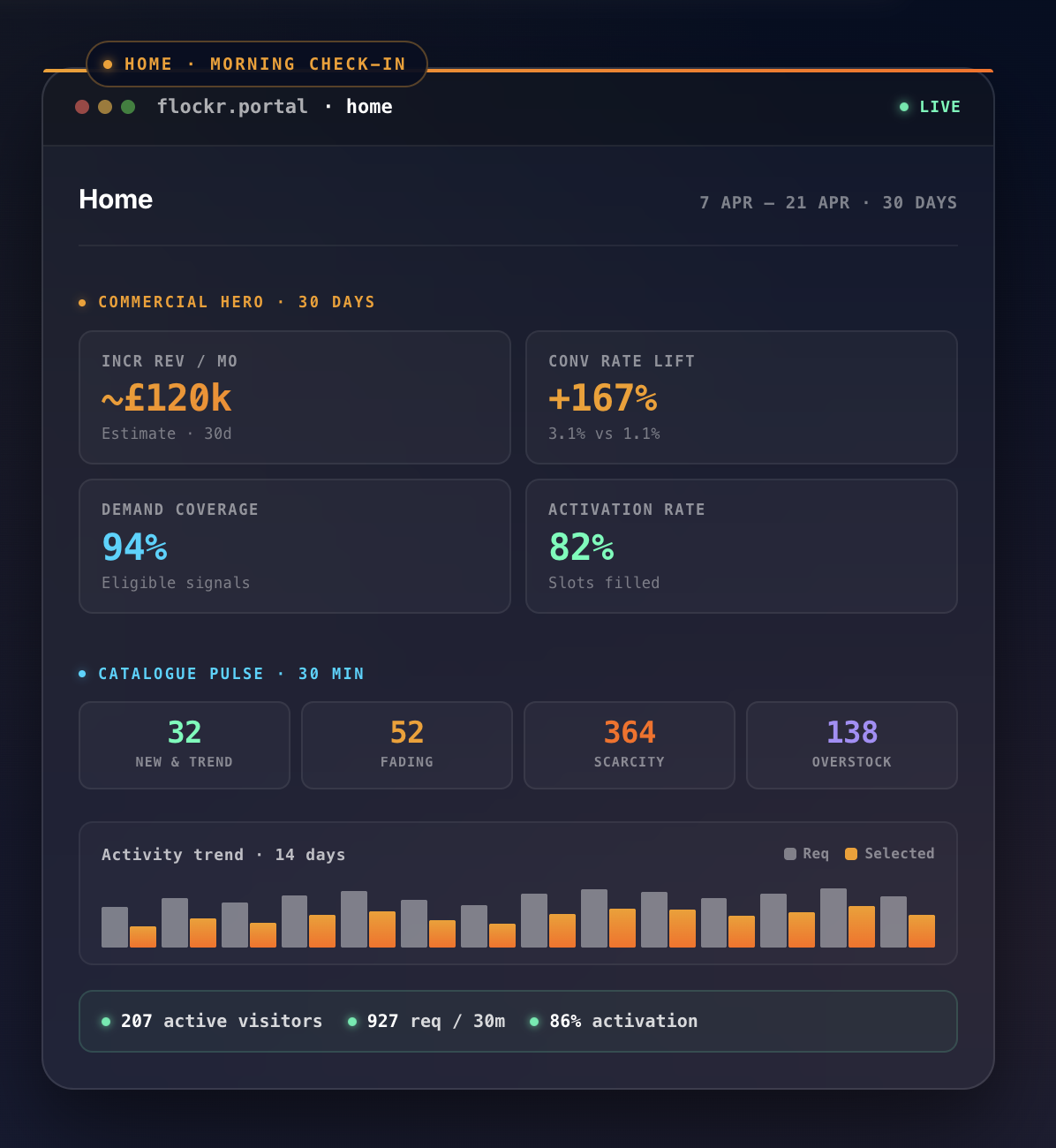
Demand intelligence is a different thing on a different time axis. Where forecasting and planning look forward over weeks and quarters to decide how much to buy, demand intelligence reads what is happening to demand right now, per product, on the storefront — and surfaces it while there's still time to act on the shopper-facing moment. It doesn't replace the forecast; it fills the gap the forecast structurally leaves open. A forecast made in advance can't tell you that a particular product started selling out this afternoon, or that a new-season line is quietly stalling three days after launch. Demand intelligence can, because it's built from live behaviour rather than historical sales.
The simplest way to hold the three together: forecast to plan, plan to provision, and use demand intelligence to operate in the moment between. We've written about the operational layer in detail in What is demand intelligence? — this guide focuses on the forecasting side and where the two meet.
Key elements of effective demand forecasting
Good forecasting is less about any single clever model and more about the quality of three inputs: the data you feed it, the patterns you account for, and the inventory logic you wrap around the output.
Data collection and analysis
Every forecast is only as good as the history behind it. The foundational dataset is your own sales history — units sold per product, per period, ideally several years deep so the model can see repeating cycles. To that, strong forecasting adds context the raw sales numbers don't contain: promotional calendars (so the model doesn't mistake a past discount-driven spike for baseline demand), pricing changes, stockout periods (a product that sold zero because it was unavailable did not have zero demand), marketing spend, web traffic, and channel mix. The analysis step is largely about cleaning and reconciling this — removing the distortions that would otherwise teach the model the wrong lesson. Most forecasting failures trace back to data problems, not model choice.
Seasonal trends and consumer behavior
Almost every e-commerce catalogue carries seasonality, and the best forecasts model it explicitly. There's calendar seasonality (Q4 peaks, summer lulls), event-driven demand (Black Friday, end-of-season sales, paydays), and category-specific cycles (swimwear, knitwear, back-to-school). Techniques such as seasonal decomposition separate a product's underlying trend from its repeating seasonal pattern, so you can project each forward correctly. Layered on top is consumer behaviour that shifts over time — changing tastes, the rise and fall of trends, the effect of a product going viral — which is exactly the part of demand that historical seasonality can't anticipate, and where real-time signals (covered later) earn their place.
Inventory demand forecasting techniques
Forecasting feeds directly into inventory decisions, and several established techniques convert a demand estimate into a stocking policy. Safety stock calculations buffer against forecast error and supply variability. Reorder point logic determines when to reorder based on lead time and demand rate. Economic order quantity (EOQ) balances ordering costs against holding costs. ABC analysis segments the catalogue by value so forecasting effort concentrates where it matters most. None of these is a forecast in itself; they're the rules that translate a forecast into "order this many, at this point" — the bridge from prediction to purchase order.
AI demand forecasting: transforming the process
For decades, demand forecasting ran on statistical time-series methods. Machine learning has changed both what's possible and what's practical, particularly for e-commerce catalogues with thousands of SKUs and short product lifecycles.
Benefits of using AI in demand forecasting
The advantages are most pronounced exactly where classical methods struggle. AI models handle scale — forecasting tens of thousands of SKUs individually, where manual or spreadsheet forecasting forces coarse category-level approximations. They capture non-linear patterns and interactions that linear statistical models miss. They incorporate many more variables at once — price, promotion, weather, web traffic, competitor activity — rather than projecting from sales history alone. And many produce probabilistic forecasts (a range with confidence levels) rather than a single number, which is far more useful for setting safety stock intelligently.
How AI improves forecast accuracy
Beyond raw modelling power, AI lifts accuracy in three specific ways. It learns continuously, retraining on new data so the forecast adapts to shifting conditions rather than going stale. It models cross-product effects — substitution and cannibalisation — that traditional methods, which forecast each product in isolation, structurally cannot see; when one product sells out, a good model knows demand migrates to its near-substitute. And it handles new products and short histories better through techniques that borrow patterns from similar items, addressing the cold-start problem that makes new-season ranges so hard to forecast from history alone.
Popular AI demand forecasting software
The forecasting software market splits into two broad tiers. At the enterprise end sit supply-chain planning suites — Blue Yonder, o9 Solutions, Kinaxis, RELEX, and Anaplan among them — built for large retailers and manufacturers, with deep S&OP, replenishment, and exception-management capabilities, and implementation projects to match. At the e-commerce end are leaner, faster-to-deploy tools aimed at Shopify and DTC brands — Inventory Planner, Netstock, Cogsy, and Prediko among them — which connect demand forecasts directly to purchase-order workflows so a merchant can act on them without a planning team.
It's worth being precise about where Flockr sits, because the names get conflated: Flockr is not demand forecasting software. It doesn't predict next quarter's units or generate purchase orders. It's a real-time demand intelligence layer that reads live storefront demand and acts on the shopper-facing moment — a complement to a forecasting tool, not a substitute for one. A retailer running Inventory Planner to decide what to buy and Flockr to read and act on live demand on the storefront is using each for the job it's built for. More on that distinction below.
Sales forecasting techniques for e-commerce
Qualitative vs quantitative forecasting
Qualitative methods rely on human judgement and are used where historical data is thin or absent — expert opinion, the Delphi method, market research, sales-team input. They're indispensable for genuinely new products or new markets, and unreliable as a primary method at scale because human judgement doesn't extend across thousands of SKUs. Quantitative methods derive the forecast from data: time-series models that project a product's own history forward, and causal models that relate demand to driving variables. Mature forecasting blends the two — quantitative as the backbone, qualitative judgement layered on for products and events the data can't speak to.
The role of historical data in sales forecasting
Historical sales data is the bedrock of quantitative forecasting, and understanding its limits is as important as using it. History captures repeating patterns — trend, seasonality, the response to past promotions — extremely well. What it cannot capture is anything genuinely new: a sudden shift in taste, a product unexpectedly going viral, a competitor's move, demand for a line with no past at all. This is the structural ceiling of any history-based forecast, and it's precisely the gap that real-time signals are needed to close. A forecast tells you what's likely based on what's happened; it can't tell you what's happening.
Advanced techniques: machine learning and predictive analytics
The current state of the art combines several approaches. Gradient-boosted tree models (and increasingly deep-learning architectures built for sequences) capture complex, non-linear demand patterns. Probabilistic forecasting predicts a full distribution of outcomes rather than a point estimate, so inventory policy can be set against a real measure of uncertainty. Predictive analytics more broadly folds in external signals — macro trends, weather, search-interest data — to sharpen the view. These methods materially improve forecast accuracy. They remain, by definition, predictions made in advance — which is why the most resilient e-commerce operations pair them with a real-time read of what demand is actually doing.
Underneath the software, a handful of forecasting techniques do the actual work. Knowing them helps you understand what your tools are doing and where their limits lie.
Beyond the forecast: the real-time layer
Here is the limit no forecasting method escapes, however advanced: a forecast is made before the period it describes, from data about the past. It is the right tool for the questions it answers — how much to buy, how much to hold, how to plan the season. It is the wrong tool for a different and equally commercial set of questions that can only be answered during the period, on the storefront, in time to act:
- Which products are breaking out right now — accelerating faster than their own baseline — so they can be amplified while interest is live, not after the weekly report?
- Which products are about to sell out while still in demand — short stock runway against rising velocity — so the revenue can be protected before it's lost?
- Which are quietly fading — declining in real terms while still looking healthy on cumulative numbers — so spend can be pulled before it's wasted?
- Which are accumulating as dead stock early enough to clear them gently, rather than at an end-of-season write-down?
These are demand intelligence questions. The nearest concept in the supply-chain world is demand sensing — short-horizon forecasting that uses near-real-time signals to adjust replenishment — but demand sensing is still a supply-side, predictive discipline aimed at the warehouse. Demand intelligence as Flockr builds it is storefront-side and operational: a live, per-product demand model that classifies every product's lifecycle state, scores its momentum against its own baseline, tracks scarcity and overstock risk, and emits an event the moment something meaningful changes — then acts on that read across the storefront and the rest of the stack. Forecasting plans the season; demand intelligence runs the day. The two together cover what neither covers alone. We cover the operational decisions this changes in demand intelligence for e-commerce.
The three line up across the same dimensions — the question each answers, its time horizon, what it's built from, where it operates, and who it serves:
Demand forecasting answers how much should we buy? Its horizon is weeks to quarters, it's built from historical sales, it operates inside the planning tool, and it serves planners, buyers, and finance.
Demand sensing answers how should we adjust replenishment? Its horizon is days to weeks, it's built from near-real-time supply signals, it operates in the supply chain, and it serves supply-chain teams.
Demand intelligence answers what's happening to demand right now, and what's the strongest response? Its horizon is seconds to hours, it's built from live storefront behaviour, it operates on the storefront and across the stack, and it serves growth, merchandising, and the storefront itself.
Best practices for implementing demand forecasting
Whichever tools you choose, a few practices separate forecasting that earns its keep from forecasting that quietly misleads.
Setting up a robust demand planning framework
Start with clean, reconciled data and a clear segmentation of the catalogue — not every product warrants the same forecasting effort, and ABC analysis concentrates it where it pays. Define the forecasting cadence and horizon to match your replenishment lead times, agree a single owned forecast across teams rather than competing spreadsheets, and instrument accuracy from day one (you can't improve what you don't measure). A framework is as much about process and ownership as about the model.
Regular review and adjustment of forecasts
A forecast is a living estimate, not a fixed target. Build in a regular review cadence where actuals are compared against forecast, error is tracked by product and category, and the model is adjusted for what it got wrong. The discipline of measuring forecast error (using a consistent metric such as MAPE) and feeding it back is what compounds accuracy over time. This is also where the real-time layer earns its place in the loop: live demand signals surface the divergences between forecast and reality as they emerge, rather than at the next scheduled review.
Using forecasting and demand tools efficiently
The most effective stacks don't ask one tool to do everything. They use a forecasting or demand-planning tool for the planning horizon — what to buy, how much to hold — and a real-time demand intelligence layer for the operating horizon — what to amplify, protect, and clear today. Used together, each covers the other's blind spot: the forecast brings the foresight history affords, demand intelligence brings the responsiveness history can't.
The future of demand forecasting in e-commerce
Forecasting is getting better — more probabilistic, more context-aware, better at the cold-start problem that has always made new products hard. But the larger shift is architectural: leading e-commerce operations are no longer treating the forecast as the single source of demand truth. They're pairing it with a live, real-time read of demand that closes the gap any history-based prediction structurally leaves open. The forecast still answers how much to buy. The live layer answers what's happening now — and increasingly, it's the second question that separates retailers who react in time from those who read about it in next week's report.
Key takeaways for e-commerce success
Demand forecasting predicts future demand from historical data, and remains essential for planning what to buy and hold. AI has materially improved forecast accuracy — at scale, across many variables, with probabilistic outputs and cross-product modelling. The right software depends on your size: enterprise suites for large retailers, lean e-commerce-native tools for DTC brands. But every forecast shares one structural limit — it's made in advance, from the past — and the most resilient operations close that gap with real-time demand intelligence: forecast to plan the season, demand intelligence to run the day.
If you want to see what it looks like on a real catalogue, book a walkthrough.