
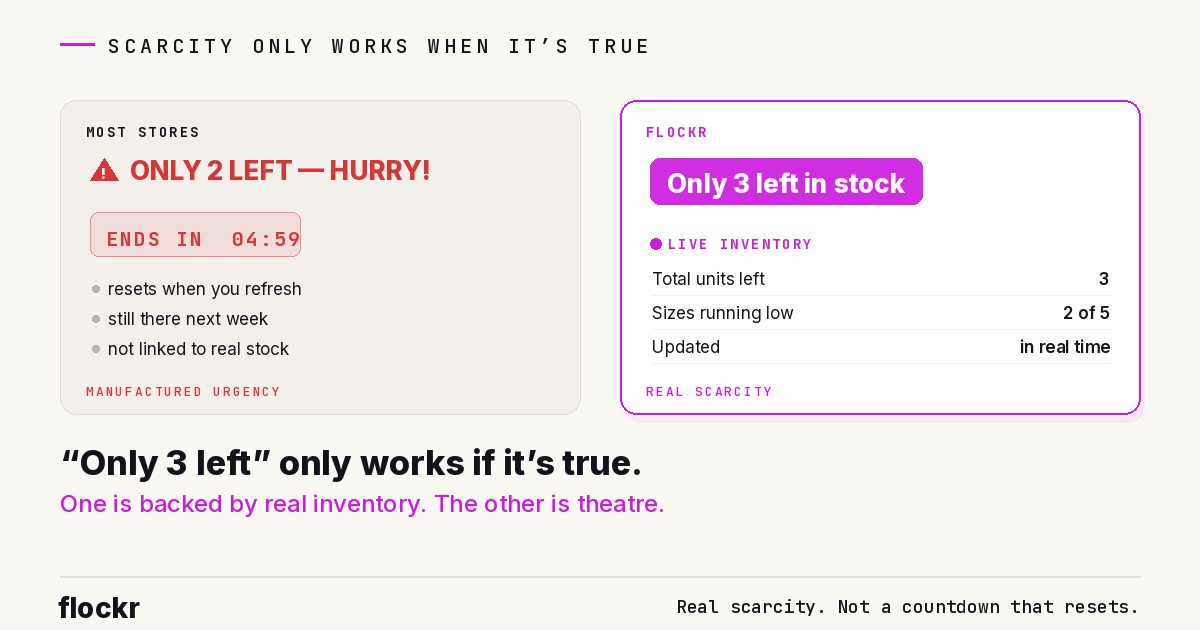
"Only 3 left" only works if it's true
Low-stock messages are among the most persuasive things you can show a shopper — and among the most abused. The difference is entirely in whether the message is true. Here's the machinery that makes Flockr's scarcity real, in full.
You've seen the fake version a hundred times. The countdown that resets when you refresh. The "Only 2 left!" that's still there next week. The urgency banner that has nothing to do with the actual shelf. Manufactured scarcity is everywhere in e-commerce, and shoppers have learned to read straight through it.
Which is a genuine loss, because real scarcity is one of the most useful things you can tell someone. "There really are only a few of these left" is information a shopper wants — it helps them decide, and decide now. The problem was never scarcity as a message. It's that so much of it is a lie, and one obvious lie teaches a shopper to distrust every message you show them afterwards.
So the interesting question isn't how to write a low-stock message. It's how to make sure it's true — every time, on every product, at the exact moment it's shown. That turns out to take a fair amount of machinery, and this post walks through all of it, because the machinery is the whole point: it's what separates honest scarcity from theatre.
A low-stock message is a promise
Start with what the message actually is. "Only 3 left in stock" is a factual claim about the world, made to a shopper at the moment they're deciding whether to buy. If it's true, it's one of the strongest, most legitimate nudges in retail. If it's false, you haven't just stretched the truth on one product — you've told that shopper your messages can't be trusted, and they'll discount the next one, and the one after that.
That's why, for Flockr, low stock is driven by inventory truth rather than behaviour. Most of Flockr's signals read what shoppers are doing — views, add-to-baskets, purchases, momentum. Low stock is different in kind: it reads how many units of a product actually exist to buy, in real time. It isn't a soft behavioural trend that's probably directionally right; it's hard evidence. Which is also why it's one of Flockr's most trusted signals, and competes confidently for the limited message slots on a page — though it won't always win, because a fresher or stronger signal can still outrank it.
Built from a live inventory feed
Every time a product's stock changes — a sale, a return, a restock, a manual adjustment — the store sends Flockr an inventory update for the affected variant. Flockr processes these as they arrive, so the stock picture it holds tracks the real store in near real time.
It doesn't try to reason about every individual variant at the moment a shopper loads the page — that would be slow and needless. Instead, each time an update arrives, Flockr recalculates a compact stock summary for the whole product and stores it. Every later decision reads that ready-made summary. The summary holds four things: the total units available across all variants, how many variants are still in stock (how many sizes you can still buy), how many variants are individually running low, and a single low-stock flag — the inventory feed's own verdict on whether the product, as a whole, should count as low.
That last flag is where the intelligence sits, so it's worth seeing exactly how it's computed.
Why a product can be "low" with plenty of stock
Here's the insight that separates this from a naïve unit count. Imagine a jacket with two hundred units in the warehouse — but almost all of them are XXL, and the mediums and larges that most people want are down to their last one or two. By a total-units measure, that product looks perfectly healthy. To the shopper who wants a medium, it's nearly gone.
So Flockr works at the variant level. Every time inventory updates, it evaluates the product like this.
First, it counts two things across the variants: the in-stock variants (those with at least one unit available) and the low variants — the ones that are in stock but running out. A variant counts as low when it has one or two units left: its available quantity is above zero but below three. A variant sitting at zero is out of stock, not low, and isn't counted in either bucket.
Then the low-stock flag is set to true when either of two conditions holds:
- The variant ratio. At least 40% of the still-buyable variants are low — formally, low variants ÷ in-stock variants ≥ 0.4. A product with five buyable sizes is flagged the moment two of them drop to their last couple of units (2 ÷ 5 = 0.4). This is the condition that catches the jacket above: the total looks fine, but the majority of the sizes a shopper can actually buy are nearly gone.
- The near-exhausted shortcut. The product is down to a very narrow range with very few units — two or fewer in-stock variants and six or fewer total units across the whole product. This catches products with only one or two options left, each nearly gone, where the ratio alone might not trip.
If no variants are in stock at all, the flag is false — a product with nothing to sell is out of stock, which is a different state entirely.
When a shopper then loads a page, Flockr reads the summary and makes the final call. A product is treated as low stock when either that variant-aware flag is set, or the total units available is simply small — at or below ten. Two independent paths, on purpose: the first trusts the nuanced, variant-aware verdict that can fire even when totals look fine; the second is a plain safety net, so a genuinely scarce product still triggers even if the subtler flag never fired.
Those numbers — below three units per variant, a 0.4 ratio, the two-variant-and-six-unit shortcut, the ten-unit net — are the current defaults, and they're tunable per configuration. What's fixed is the shape: a per-variant low test, then a ratio across buyable variants, then a narrow-range shortcut, then a total-units backstop. The shape is the design; the exact dials can be set to a store's own sense of "scarce."
It never claims more than it knows
Flockr always picks the most specific wording it can actually justify, working from most precise to most general.
When the total is small and specific — ten or fewer units — it uses the strongest, most concrete form: "Only 3 left in stock." This is typically a single-option product, or one genuinely down to a handful of units, where the exact number is real and worth stating.
When the product has several variants, like clothing sizes, it describes the shape of the scarcity rather than inventing a single number: "Almost sold out" when nearly every size is nearly gone, "Most sizes are nearly sold out" when more than half are low, "Low stock in many sizes" or "Low stock in some sizes" as the proportion falls. The message tells the truth about a multi-size product without pretending there's one tidy count.
And when Flockr knows only that the product is low, with no useful counts to draw on, it falls back to a plain, honest "Low stock available."
The result is that the same underlying signal reads very differently by situation — a precise "Only 3 left" for a nearly-gone item, a size-aware "Low stock in many sizes" for an apparel product whose popular sizes are thinning, a simple "Low stock available" when only the broad picture is known — and every version is true. Flockr never claims more precision than the data supports.
There's one refusal worth calling out, because it's the clearest expression of the whole principle: a product with zero units available is never "low stock." It's out of stock — a different state — and Flockr will not show a low-stock message for something with nothing to sell. A shopper will never see the absurd, trust-destroying "Only 0 left."
Deciding a product is low stock is only half the job. The other half — and the part that most directly protects trust — is choosing how to say it, because a single low-stock decision can be expressed with very different levels of precision, and claiming more precision than you have is its own kind of lie.
The most persuasive message it can show
Scarcity gets stronger in company. Flockr has a separate signal for live cart pressure — how many shoppers currently have an item in their cart — and when that pressure coincides with tight stock, the two combine into a single, more urgent message: "12 shoppers have this in their cart right now. Only 3 left in stock." Lots of people want it, and there's barely any left. It's the most persuasive thing Flockr can say, and it's the multi-signal approach at its sharpest.
But notice the discipline. That hybrid uses a stricter stock bar than a standalone low-stock message — it only claims low stock when units are down to about five or fewer, rather than ten — so the combined urgency is reserved for products that are genuinely near-critical. Flockr won't manufacture the compound just because it's compelling; it earns it, or it doesn't show it. The reward for that restraint is that when the combined message does appear, it deserves to be believed — and it competes more strongly for its slot precisely because both halves are real.
Everywhere it matters
One last thing sets low stock apart: it's the most broadly eligible message Flockr produces. It's allowed on every surface — product pages, listing and category pages, the cart and cart drawer, search and predictive search, recommendation carousels, even checkout. That breadth is deliberate. Genuine scarcity reduces hesitation at any point in the journey, so it survives even the strict filters Flockr applies at checkout and in predictive search, moments where softer signals are held back. Wherever a product can carry a message, honest scarcity earns a place.
The mirror image
There's a natural other half to all of this. The same live inventory truth that detects a product running out also detects it coming back — and Flockr's restock messaging ("Back in stock," and size-aware variants) is the mirror image of everything above, built on the same feed and mutually exclusive with low stock by design: a product can't be freshly restocked and running out at the same moment, and when stock tightens again, low stock takes back over. That's a story worth telling properly on its own, an it's covered on the restock messaging post.
For now, the point is the one we started with. Scarcity is one of the most powerful messages in retail, and one of the most abused — and the only version worth showing is the kind that's true. Everything above is what "true" costs. If you'd like to see honest scarcity running on your own catalogue, the social proof messaging page walks through it, or you can book a walkthrough on a real store.