
What is social proof messaging?
You've seen social proof messaging thousands of times, probably without naming it. "Only 3 left in stock." "12 people bought this in the last 24 hours." "Bestseller." "Selling fast." These short lines, sitting next to a product as you browse, are social proof messaging: the storefront's way of telling you what other shoppers are doing, at the moment you're deciding whether to do the same.
Social proof messaging, explained
It's a narrower, more specific thing than "social proof" in general — which spans reviews, influencer posts, press coverage, and testimonials. Social proof messaging is the live, on-store layer: the messages computed and shown during a shopping session, on the product being looked at, about what's happening with that product right now. This piece explains what those messages are, the forms they take, where they appear, how the right one gets chosen, and the line that separates a message worth showing from one that quietly costs you.
The purpose is straightforward. When a shopper is uncertain, evidence that other people are choosing the same product reduces the risk of the decision. A product page that says nothing leaves the shopper to judge in a vacuum; a product page that says "selling fast — 40 bought today" supplies independent evidence at exactly the point it's useful. Done well, it's not persuasion so much as information: the store surfacing something true that the shopper would otherwise have no way to see.
That word — true — is what the rest of this piece turns on.
What a social proof message is actually made of
Every social proof message is a claim backed by a signal. The claim is the line the shopper reads; the signal is the measured fact underneath it. "12 bought in the last 24 hours" is a claim; the signal is a purchase count, measured on that product, in that window. "Only 3 left" is a claim; the signal is a live stock level.
This is the whole architecture in one sentence: the message is the legible surface of a signal. A well-built system decides what's true first — reads the signal — and only then renders the wording. The copy is the easy part; the measurement is the product. Which is why the interesting question about any social proof message isn't "is the wording compelling" but "what signal is this message standing on, and is that signal real?"
The main types of social proof message
Most social proof messaging reduces to a handful of recognisable types, each expressing a different kind of demand. Flockr computes seventeen message types from eleven families of behavioural signals; the common ones illustrate the range:
- Purchase — "40 bought in the last 24 hours." The strongest form of proof: people didn't just look, they paid.
- Attention / views — "120 people viewed this recently." Interest in motion, useful earlier in the journey when purchase counts are still thin.
- Add-to-bag intent — "15 added to bag in the last hour." A step beyond viewing — commitment short of checkout.
- Scarcity — "Only 3 left in stock." Demand expressed through dwindling supply, and the type most often faked, which is why it has to be tied to live inventory.
- Cart pressure — "8 shoppers have this in their cart right now." Real-time competition for limited stock.
- Rating — "4.6 stars from 312 reviews." Accumulated reputation rendered as a live message.
- Newness — "Recently added and already gaining attention." Proof for products too new to have deep history.
- Rank — "Bestseller," "Most viewed," "Most reviewed." A product's standing relative to the rest of the catalogue.
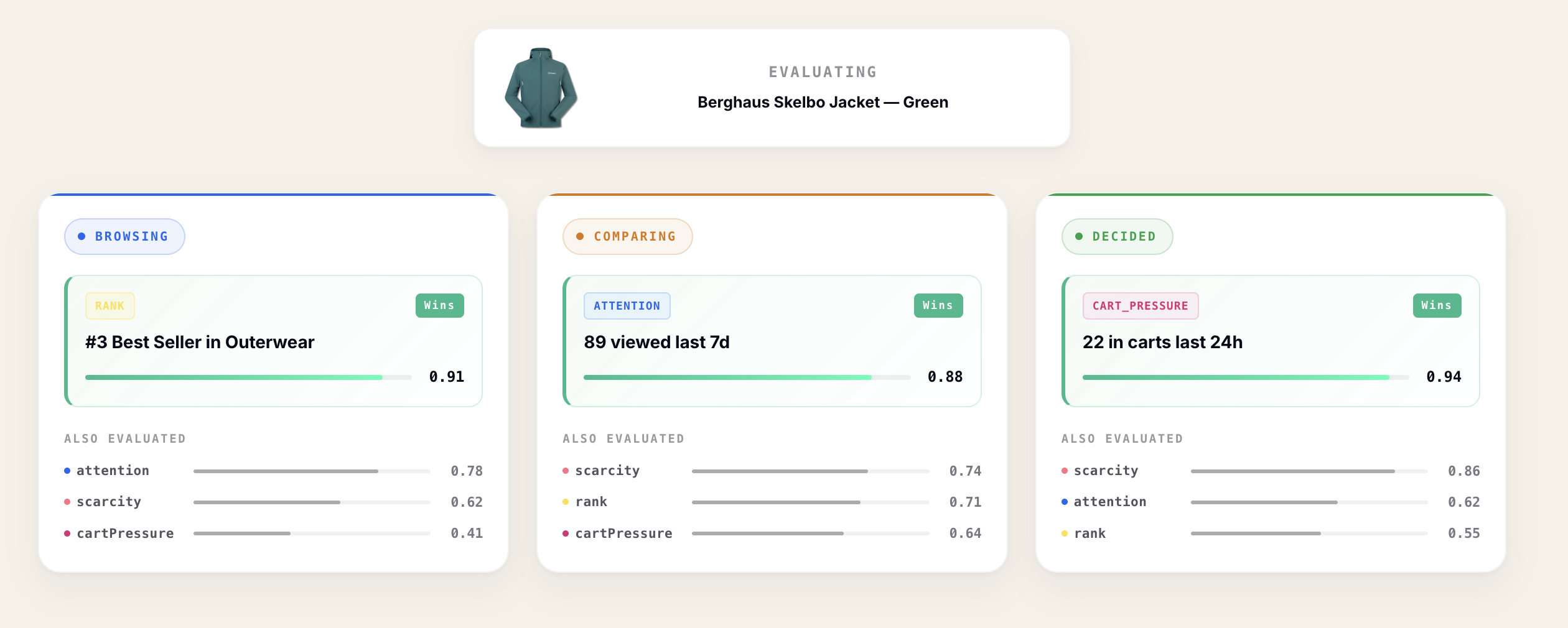
The point of having a range is that different products, at different moments, have different true things to say. A new arrival has no purchase history but may be gaining views fast; a long-seller has deep reviews but flat momentum. The job of a messaging system is to find the strongest true claim available for each product, rather than forcing the same badge onto everything.
Where social proof messages appear
A social proof message is only as good as its placement — it has to reach the shopper at a point where the decision is live. In practice that means the message moves with the shopper across the whole journey, not just the product page. Flockr places messages across eight storefront surfaces:
The product detail page is the highest-intent surface, where a shopper is already focused on one item and a message has room to make a full claim. Collection and category pages (PLPs) and search results carry messages on individual product tiles, helping a product stand out among many. Predictive search — the dropdown as someone types — and recommendation carousels surface proof earlier still. And the cart drawer, full cart page, and checkout carry messages at the closing stages, where scarcity and cart-pressure signals do their most useful work.
The same message also has to adapt to the space it's in. A full two-line message that reads well on a roomy product page is wrong for a narrow search tile, so a good system renders a shorter variant — heading only, or a trimmed line — where the slot demands it. Same underlying signal, different rendering, surface by surface.
How the right message gets chosen
A busy product might have several true things that could be said at once — it's selling well, it's low on stock, and it's a bestseller. Showing all of them would be noise. So the core of social proof messaging is selection: on each page load, the system evaluates every product in view and, for each available message slot, picks the single strongest, most relevant claim that's true right now.
Three principles make that selection trustworthy rather than gimmicky:
It's surface-aware. A claim that fits a product page may not fit a search tile; eligibility is judged per surface, not applied blanket across the store.
It's threshold-gated. A message only shows when the signal behind it is genuinely strong enough to count. "2 people viewed this today" isn't proof of popularity — it reads as proof of the opposite — so below a confidence threshold, the system shows nothing rather than something weak.
It's deliberately sparse. A good system does not message every product on the page. A storefront plastered with badges on every tile reads as decoration, and shoppers discount all of it. Spreading activation across only the products with real signals is what keeps the messages that do show credible.
That last principle is counterintuitive and important: the restraint is the point. The willingness to stay silent on a weak product is what protects the message on a strong one.
Real, not authored: the line that defines good social proof messaging
Here is the distinction that separates social proof messaging worth running from the kind that becomes a liability. A legitimate message is computed live, never authored, never invented — it exists because the system measured the underlying fact, on that product, recently. A fabricated message is one a merchandiser switched on by hand and left running: the "selling fast" badge applied weeks ago to clear stock, the countdown timer that resets on refresh, the viewer counter driven by a random number.
The test is simple, and you can apply it to any store including your own: can this message be traced to a signal that was actually measured, on this product, recently? If yes, it's social proof. If no, it's set dressing — and increasingly a regulatory exposure, as authorities on both sides of the Atlantic move against fabricated urgency and scarcity claims. We go deeper on this in the pillar guide to social proof in e-commerce; for now the short version is that the integrity of a social proof message lives entirely in whether there's a real signal underneath it.
Where social proof messaging fits
Step back, and social proof messaging turns out to be the visible tip of something larger. To compute the right true message for every product, continuously, a system has to maintain a live read of demand across the whole catalogue — what's being viewed, carted, bought, and running low, per product, in real time. That underlying layer is demand intelligence, and social proof messaging is its most legible output: the point where the live demand model becomes a sentence a shopper can read.
This is why the message is best understood as an output, not an input. Nobody writes the rule "show selling fast on this product"; the system shows it because the demand state says it's true. The messaging is the surface. The intelligence is the product. If you want to see how Flockr turns live demand into storefront messaging in practice, the social proof messaging platform page walks through it — or book a walkthrough on a real catalogue.
If you want to see what it looks like on a real catalogue, book a walkthrough.