
A CDP models people. This models demand.
Demand intelligence and customer data platforms both call themselves data platforms, and they answer completely different questions. Here is the axis your CDP does not have, and the cohorts it can only build with demand on the other side.
When demand intelligence comes up in a stack conversation, a fair question usually follows: isn't this roughly what our CDP does? Both are "data platforms". Both sit in the middle of the stack. Both end in activation. The budget line even has a name for this territory, and it says CDP on it.
The confusion is reasonable, and the answer is not that one is better. It's that they sit on different axes entirely, and the fastest way to see it is to ask each system the question the other exists to answer. Ask a CDP what is happening to a product's demand right now, this minute, on your storefront, and it has nothing. Ask demand intelligence who a shopper is, and it has, deliberately, nothing. Two silences, two architectures, two different halves of the same store's reality.
Not competitors. Perpendicular.

What a CDP is genuinely for
Let's do the other side justice first, because the comparison only means something if the CDP in it is the real thing rather than a straw man.
A customer data platform solves a problem every multi-channel retailer genuinely has: the same human appears as a website cookie, an email address, a loyalty number and a checkout record, and nothing agrees. The CDP resolves those fragments into one profile per person, accumulates their history against it, manages what they have consented to and on which channels, and activates audiences into the tools that talk to them: the ESP, the ad platforms, the personalisation layer.
That is real, hard, valuable work. Identity resolution across devices is genuinely difficult. Consent management is both an obligation and, done well, a trust asset. And the unified profile is the correct foundation for deciding who to contact, about what, on which channel. If the question is about people, the CDP is the right system holding the right object.
The axis it does not have
Now watch what happens when the question changes.
Your CDP can tell you that Sarah bought hiking boots in March, has a lifetime value of £1,840, opens email but ignores push, and consented to SMS last autumn. A genuinely complete picture of a person, accumulated over years.
It cannot tell you that the boots Sarah is looking at right now are accelerating toward a stockout. Or that the jacket she added to a wishlist entered its launch window nineteen days ago and is quietly fading. Or that thirty-seven other shoppers currently have that jacket in their carts. Not one field of it, and not because the CDP is deficient: because nothing in its architecture models products. Its unit of record is a person. Its time axis is accumulated history. Product demand state is a different object, changing on a different clock, and it lives in the store your tools cannot see.
This is the whole comparison in one image. The person side of reality: complete. The product side: question marks. A store runs on both.

Four clean contrasts
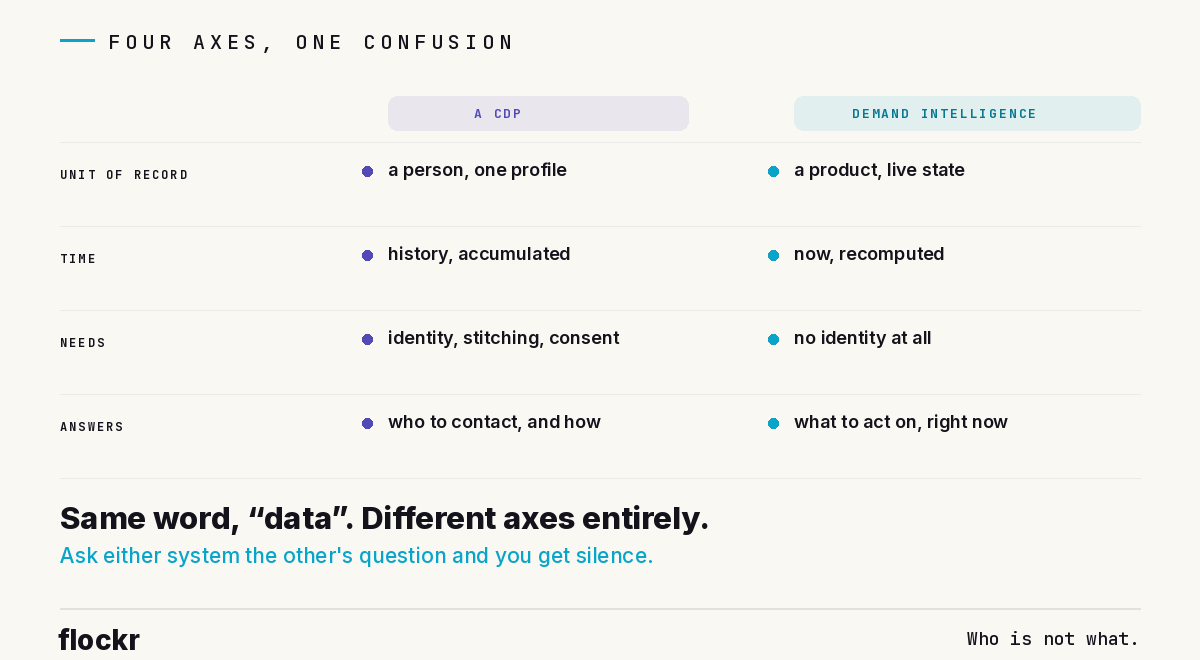
Put the two systems side by side, one axis at a time, and the perpendicularity is exact.
Unit of record. A CDP's atom is a person: one resolved profile per human, however many fragments it took to build. Demand intelligence's atom is a product: one live state per item in the catalogue, holding its momentum, lifecycle stage, rank, scarcity and cart pressure at this moment.
Time orientation. A CDP accumulates: its value grows with history, and its picture of Sarah is the sum of everything she has ever done. Demand intelligence recomputes: its value is freshness, and its picture of the jacket is what is true in the current window, not what a report will say next month.
Data requirements. A CDP runs on identity by definition: stitching, profiles, consent. That is its job and also its burden. Demand intelligence runs on aggregate behaviour: views, add-to-bags, purchases, stock, per product. It needs no identity at all, holds none, and works identically whether a shopper is known, anonymous, or opted out of everything.
Question answered. The CDP answers: who should we contact, about what, on which channel? Demand intelligence answers: what is worth saying, featuring, protecting or acting on, right now? Who versus what. Both questions matter; neither system can answer the other's.
Perpendicular in practice: the cohorts only both can make
Here is where the two axes stop being a philosophy diagram and start being useful, because perpendicular lines do something parallel ones never can: they cross.
Consider a cohort your marketing team would genuinely want: shoppers engaging with products at scarcity risk. People worth a nudge today, because the thing they want is genuinely running out.
Your CDP cannot build that segment alone. Not because its segment builder is weak; it will happily segment on any trait it holds. It's that "scarcity risk" is not a fact about a person. It's a fact about a product, computed from live stock runway crossed with accelerating demand, and no CDP holds that object. The defining trait of the audience lives on an axis the CDP does not have.
Flockr cannot reach those people alone either, and does not want to: it holds no identities to reach.
Together, the cohort is straightforward, and it works through the integration patterns that are live today: demand intelligence acts as a source the CDP ingests, routing demand context into the systems that hold identity, enriching the picture the CDP already has with the product dimension it cannot see. Demand state arrives where people-data lives; the CDP's own segment builder does what it has always done, now with demand as a dimension. Flockr supplies the what; the CDP supplies the who; the audience exists only at the intersection.

And scarcity is just the first example. Every dimension demand intelligence computes is a dimension your CDP's audiences currently lack: engagement with trending products versus fading ones, attention on new launches inside their window, browsing concentrated on products under live cart pressure. None of these audiences is buildable from identity data, however complete, because their defining trait is demand-side. This is what "perpendicular" buys you in practice: not a replacement for the CDP, but a dimension that makes the CDP's own segmentation able to say things it never could.
The privacy asymmetry
One structural difference deserves its own short section, stated carefully.
A CDP's value and its compliance burden rise together, necessarily: the better its identity resolution, the more personal data it concentrates, and the more consent, governance and regulatory surface it carries. That isn't a criticism; it's the honest cost of doing identity properly.
Demand intelligence has no such trade-off, because it models products. The signals are aggregate by design: how many viewed, how many added to bag, how much stock remains. There is no shopper identity in the system to govern, which means the demand dimension arrives in your stack adding zero identity surface to it. The intelligence layer gets sharper without the compliance ledger getting longer. In a market where every new data source usually means a new privacy review, a source with nothing personal in it is a quietly radical thing to add.
Who, and what
You need to know who: that is your CDP, and it should keep doing exactly what it does. You need to know what is happening to demand, per product, right now: that is a different system on a different axis, and in most stacks it simply does not exist yet.
The store runs on both halves. One of them you already have. The other is demand intelligence, and if you want to see the axis your stack is missing, computed live on a real catalogue, book a walkthrough and we'll show you the half your CDP was never built to see.