
Every product is somewhere
Most stores know a product's age. Almost none know its stage: where it sits in its life, computed from live behaviour. And stage is what tells you which products need you today
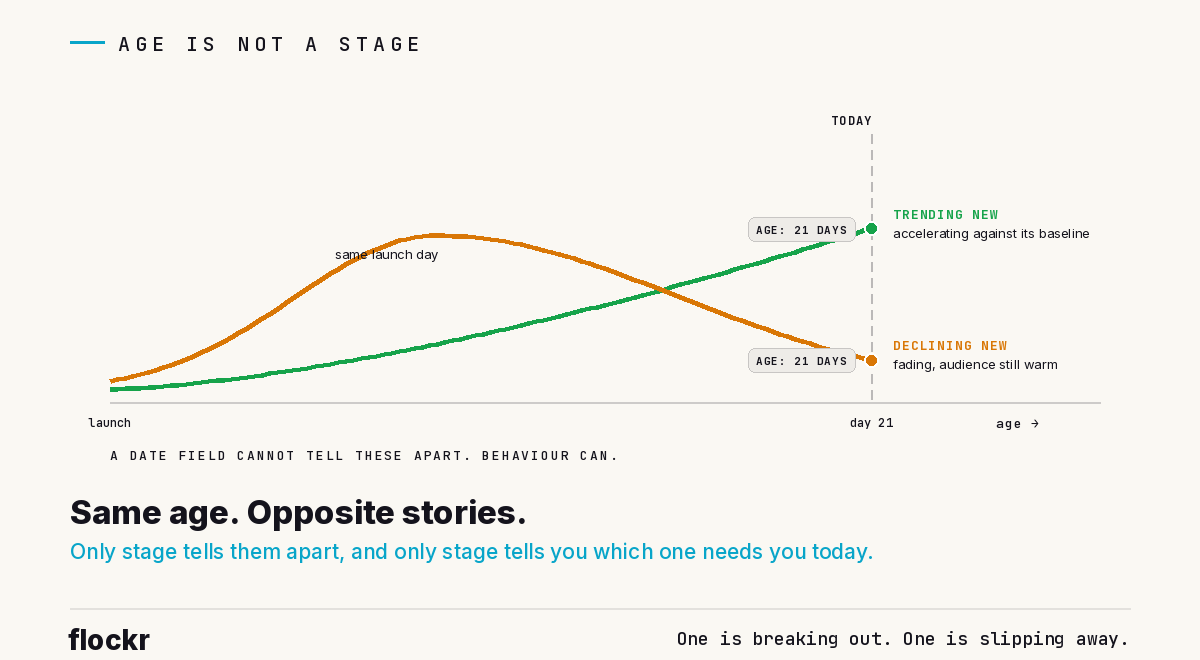
Take two products, both exactly three weeks old. One is accelerating: views climbing, add-to-bags following, demand rising faster every day against its own baseline. The other is quietly dying: it launched well, peaked in its second week, and has been sliding ever since.
Every report you own treats these two products identically, because reports know age. Days since publish. A date field. By that measure they are the same product, and they will go on being the same product until one of them shows up on a bestseller list and the other shows up in a clearance plan.
What separates them is not age but stage: where each one sits in its life, computed from what shoppers are actually doing. That distinction is the subject of this post, because demand intelligence treats a catalogue as a population rather than a list. Every product in it is somewhere in a life, and knowing where changes what you do next.
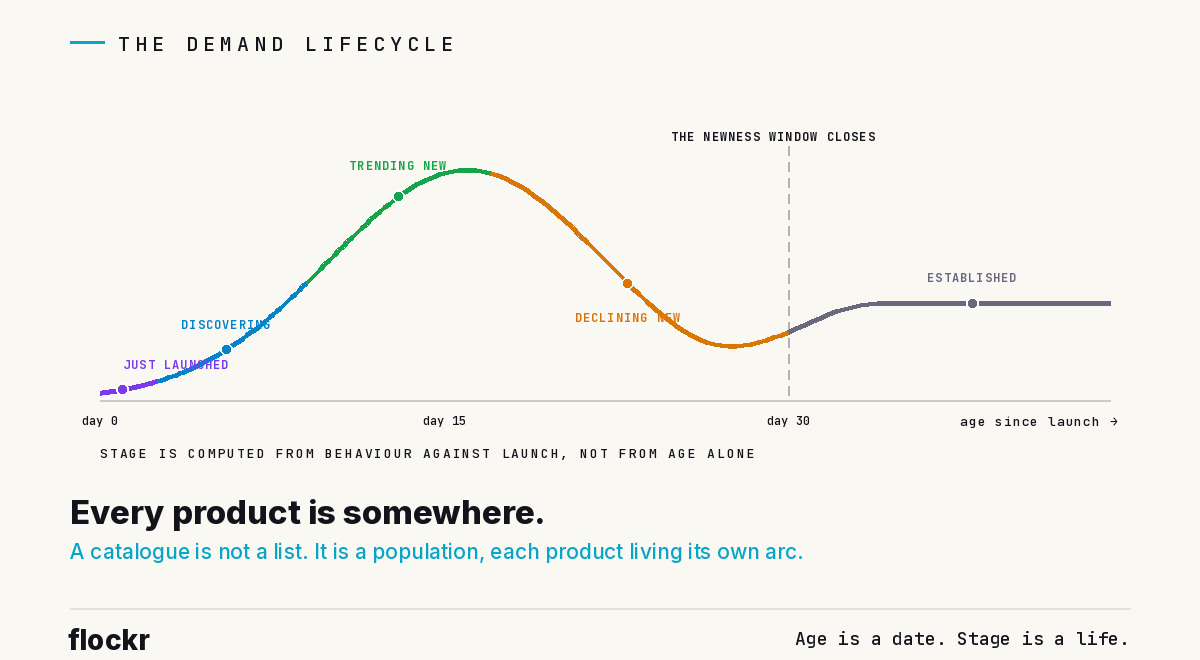
The five states
Flockr classifies every product in the catalogue into one of five lifecycle states, continuously, from its behaviour since launch.
Just launched. The product is live but has no meaningful demand history yet. It exists; the market has not spoken.
Discovering. Early interest is building. Shoppers are finding it, views are accumulating, the first add-to-bags are arriving. The story is starting but not yet told.
Trending new. Demand is accelerating against the product's own baseline. This is the launch working: a recent arrival gaining attention fast, the state every buyer hopes for when they range something.
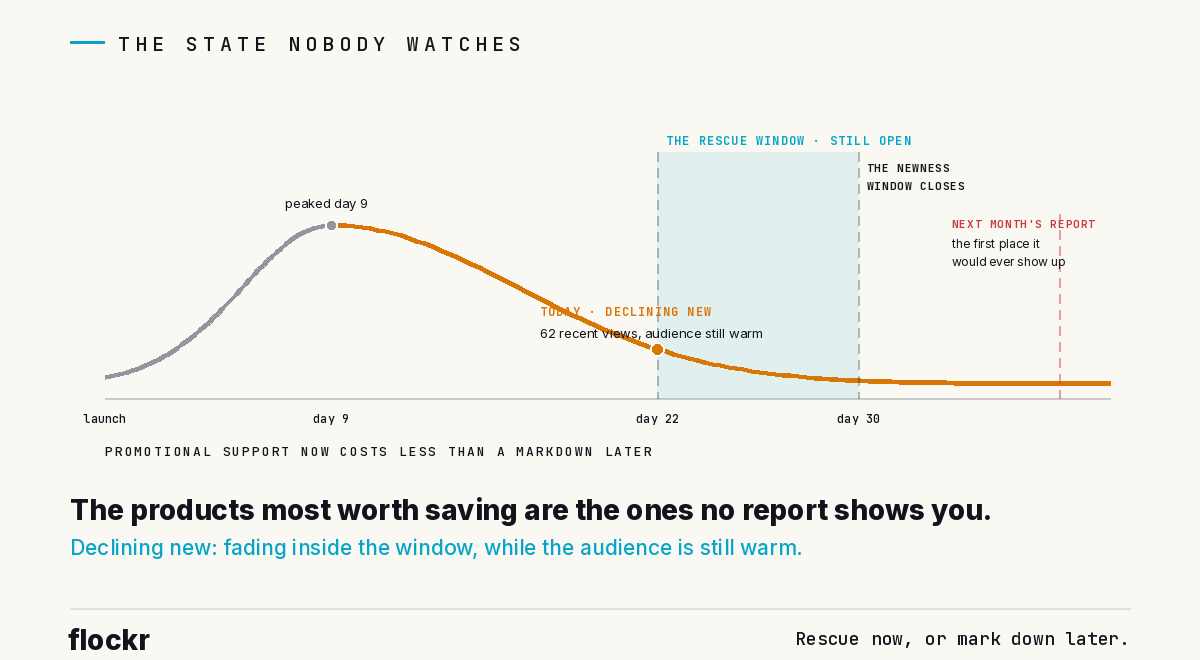
Declining new. The product is still inside its launch window, but momentum is falling. It had traction and is losing it. This state gets its own section below, because it is the one nobody else watches and the one most worth watching.
Established. The launch window has passed. The product graduates out of the newness story and competes on its ongoing merits, which is not an ending; more on that later too.
The mechanics are simple and worth stating plainly. A product's launch is recognised from its publish event, through the webhook, API or product feed the catalogue already uses, with no tagging and nothing to maintain. The window is thirty days by default, and configurable. And the stage within that window is computed from behaviour against the launch date, not from the date alone: two products of identical age can sit in opposite states, which is the entire point.
One honesty detail that says a lot about the model: products with no recorded publish date are excluded from lifecycle classification rather than guessed at. If Flockr does not know when a product launched, it does not pretend to know where it is in its life. The portal states the exclusion openly.
What stage changes
Stage is not a label sitting in a database. It drives behaviour across the platform.
It changes what shoppers see. The newness messaging is staged: a Just launched product says "Just launched, be among the first," a Discovering product says "Newly added and being discovered," a Trending new product says "A recent arrival that's gaining attention fast." Three different claims for three different truths. And a Declining new product earns no newness message at all, because "new and fading" is not a claim worth making to a shopper. The recency boost follows the same logic: a curve that peaks early and fades to nothing before the window closes, rather than a switch that is on for thirty days and then off.
It changes what your team sees. The portal holds the population view: the live distribution of the whole catalogue across the five states, refreshed every half hour. At a glance: how many products are in their first days, how many are being discovered, how many launches are genuinely working, how many are slipping, and the large settled majority that has graduated.
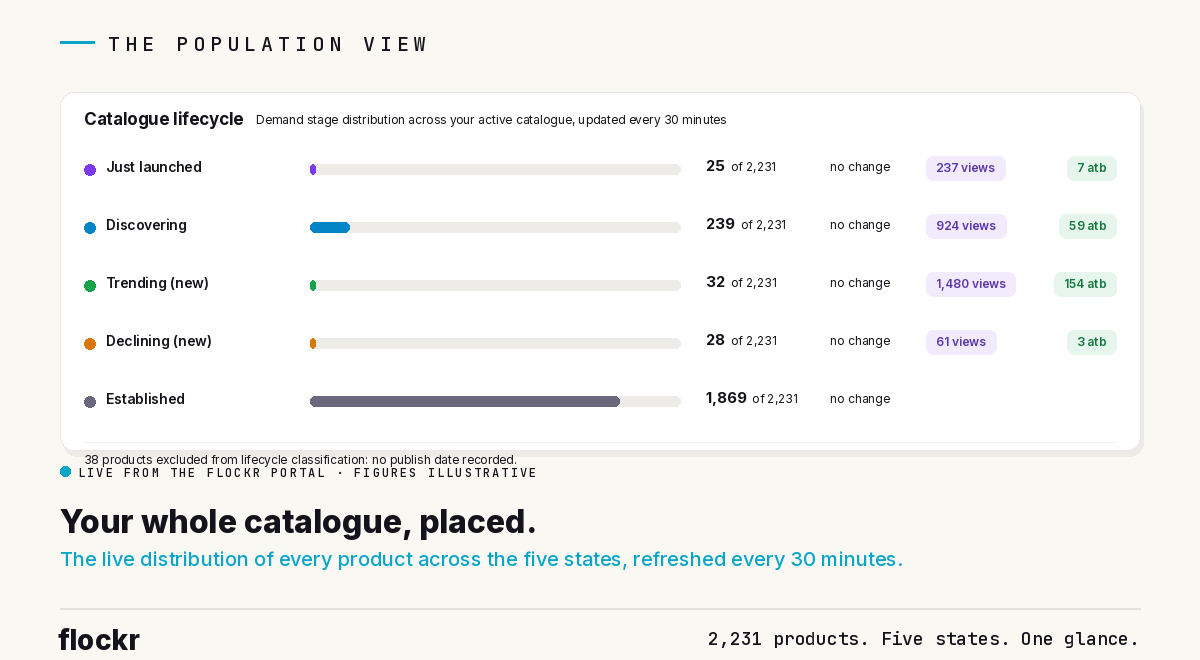
And it changes **what the intelligence pays attention to**. A breakout is only a breakout relative to where a product is in its life. Acceleration in a Discovering product means something different from acceleration in an Established one, and the insights Flockr surfaces read stage for exactly that reason.
The state nobody watches
Look back at that distribution: 28 products in Declining new. These are launches losing momentum inside their window. Real products that someone chose, bought stock for, photographed and launched, which found an audience and are now losing it, all within their first thirty days.
No conventional report surfaces them. Cumulative numbers on a young product always look plausible, because a few weeks of sales is a few weeks of sales; the total cannot show the direction. A bestseller list only shows winners. An age filter shows "new arrivals" as one undifferentiated bucket. The products most in need of attention are structurally invisible to every tool that reads age instead of stage.
Flockr puts Declining new products in their own table precisely because they are the most actionable products in the catalogue. The audience that discovered them is still warm. The window has not closed. Nothing about the product has failed; it just needs the visibility it is quietly losing, and it needs it now, because warmth decays and the window does close. A product rescued at day 20 is a launch that worked; the same product noticed at day 60 is a markdown.
Stage comes with advice
Here is the part that makes the lifecycle model more than a nicer report. Knowing where every product is in its life is useful. Knowing the shape of the whole catalogue is useful. But Flockr does not stop at telling you where things are; it tells you which products need you, why, and who should act.
The lifecycle states feed Flockr's insight layer. An insight is not an alert that something changed; it is a named, quantified finding with a recommended action attached and a route to the team that owns the decision. For the declining launches above: the count, the products, the evidence that the audience is still warm, and the recommendation, promotional or discovery placement before the window closes, routed to merchandising and discovery, with the reasoning stated. Export the list, or ask Signal to dig further.
The honesty boundary stays where it always is. Flockr recommends; you decide. The advice arrives with its reasoning, the action happens in your own tools, and the one thing Flockr does automatically is its own storefront messaging, which activates for eligible products by design. Everything else is a recommendation a human can accept, assign, or ignore.
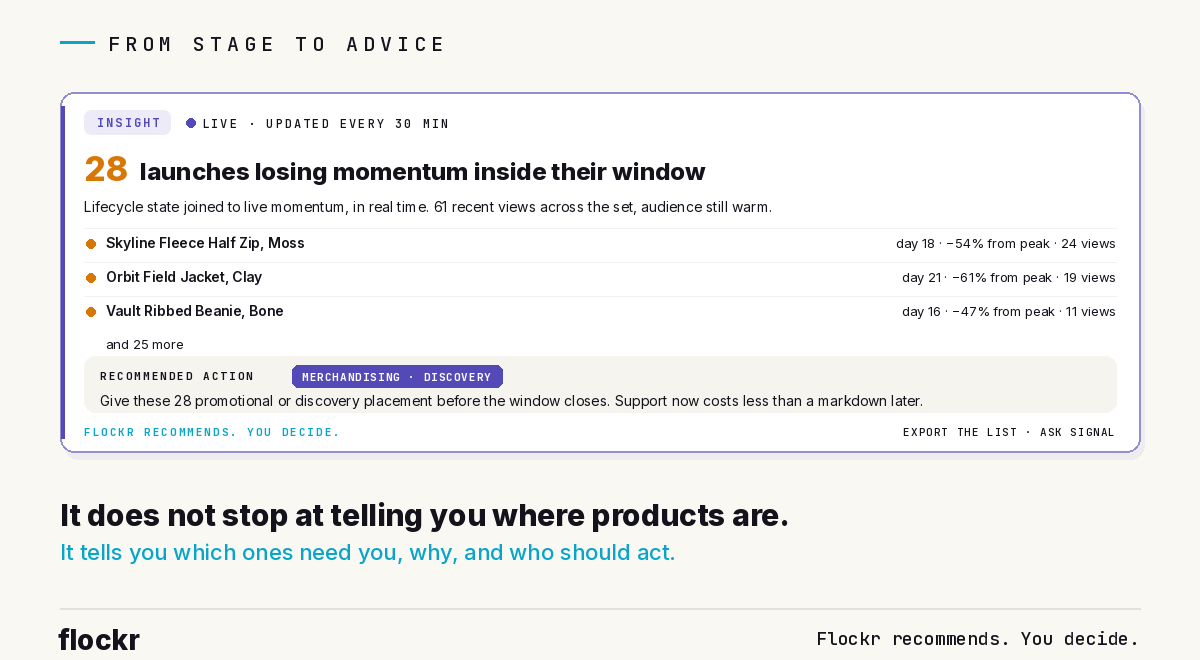
This is the same window argument that runs through everything demand intelligence does, at product-lifecycle resolution. By the time a struggling launch appears in a report, the window has closed and the choice has been made for you. Stage, read live, is what keeps the choice open.
Established is not the end
Graduation is not retirement. An Established product has simply left the launch story; it competes on its ongoing merits, and those merits are read continuously like everything else. Momentum is an any-age signal, so a two-year-old product can trend, earn messages, and lead an insight. The lifecycle model is specifically about the launch arc, because that is where timing is most decisive and where stores are most blind. Once a product is Established, the rest of the demand intelligence takes over: rankings, momentum, scarcity, the whole live state.
A list tells you what you sell
A population tells you where everything is in its life, right now: which launches are working, which are being discovered, which are slipping while there is still time, and what the settled majority is quietly doing. And an insight layer on top of that population tells you the only thing a busy team actually needs to know on a Tuesday morning: which products need you today, why, and what to do about it.
Every product is somewhere. If you would like to see where yours are, the demand intelligence page walks through it, or book a walkthrough on a real store.